Skip to content

Meditations on God

  • Robert Van Valkenburgh

  • This Is My Real Job

    Sometimes, the needs of the business take priority over our personal interests.

    Some time ago, in my first year as a General Manager (GM) for a large coffee company, I was at a development meeting with my District Manager (DM) and we were discussing labor and scheduling. He observed that I had several part-time employees on staff and questioned why I did not instead have one full-time employee in their place. We offered full benefits to both part-time and full-time employees so there was really no cost savings to hire part-time employees. His concern was that we could better serve an employee with full-time hours than part-time and that we might lose good workers if they did not get enough hours.

    I explained that I had hired a young, female employee, in her early twenties, who was working full-time, but that she had recently changed her availabilty to part-time, just over twenty hours a week. This caused me to hire another young part-time worker to fill in the hours that the original employee was no longer available for. The result was two part-time employees where one full-time employee used to be. This concerned my DM for two reasons. First, he questioned why an employee would intentionally reduce her hours from full-time to part-time. Secondly, we were now paying full benefits to two people, doubling our cost, for a position that could be filled by one person. He asked me why the original employee had limited her availability. I did not know.

    My DM asked me to call the young female employee over to where we were sitting in the cafe. When she arrived at our table, he introduced himself to her, invited her to sit down, and then he chatted with her for a while, easing the tension. Eventually, he got to the question at hand and asked her, “Why did you reduce your availabilty to only twenty hours a week?” “I have another job,” she replied. “What is your other job,” my DM inquired. “I work in a hair salon in the evenings,” she told him and then continued, “This isn’t my real job. I want to be a hair stylist.” “Oh, I see,” he replied, “Well, this is my real job. I hope you understand that we would prefer to give your hours to someone who feels the same way.”

    -Robert Van Valkenburgh teaches Taikyoku Budo and Brazilian Jiu-Jitsu at Kogen Dojo

    Share this:

    • Share on X (Opens in new window) X
    • Share on Facebook (Opens in new window) Facebook
    Like Loading…
    April 4, 2019
    business, business needs, career, dedication, focus, job, leadership, loyalty, management, manager, personal goals, personal interests, priorities, prioritizing, responsibility, work

  • The Milk Is Already On The Table

    Jiu-Jitsu White Belt: “Professor, what should I do if somene has me belly-down in back mount, hooks in, with my arms trapped under my chest, and they begin applying a rear-naked choke?”

    Professor Pedro Sauer: “Tap and start over. The milk is already on the table.”

    Robert Van Valkenburgh with Pedro Sauer in April of 2014

    The above quote is my best recollection of an actual conversation at a seminar I attended a while back with the legendary Brazilian jiu-jitsu (BJJ) teacher Pedro Sauer. Pedro Sauer is considered one of the best instructors in BJJ for his warm, calm demeanor and immaculate, finely detailed technique, so much so that his nickname is “Professor.” As an aside, it should be noted that Professor is also a rank-based title in BJJ and that Pedro Sauer is actually considered to be a Master-level instructor at this point. At the time of this seminar, I believe that he was still Professor Sauer, prior to Rickson Gracie promoting him to Master status. Either way, he is still commonly known as Professor. Back to the point.

    The milk is already on the table is, I believe, Pedro Sauer’s version of the colloquialism: There is no use crying over spilt milk. In other words, what he is saying is that there are some positions one finds oneself in, in BJJ, wherein it is simply too late for escape or reversal. Belly-down back mount, with arms trapped, and a rear-naked choke sinking in is typically one of those positions. In BJJ, at least on the mats in the academy or in competition, tapping is the ultimate reset switch. When the milk is already on the table, it has already been spilled, there is no use fretting over it, accept defeat, learn from your mistakes and start over. The alternative, in this case, is not tapping and being choked unconscious. You still lose, but with a little bit less grace and fewer brain cells.

    This sentiment of accepting a dead end for what it is, backing up a few steps, and starting over, either to retrace your steps to find out where you went wrong or to take an entirely different path altogether, is a useful metaphor for when things go wrong in life. If the milk is already on the table, clean it up and start over. Pour another glass or maybe have some coffee. Reevaluate and make a better decision for the future. Do not get hung up on the mistake, struggling to put the milk back in the glass.

    -Robert Van Valkenburgh teaches Taikyoku Budo and Brazilian Jiu-Jitsu at Kogen Dojo

    39.073857 -76.547111

    Share this:

    • Share on X (Opens in new window) X
    • Share on Facebook (Opens in new window) Facebook
    Like Loading…
    March 30, 2019
    bjj, brazilian jiu-jitsu, coffee, coffee shop, gracie jiu-jitsu, kogen dojo, Martial Arts, master, pedro sauer, professor, spilt milk

  • Taikyoku Aikido and Aikido of Pittsburgh

    In the Spring of 2014, I attended my first aikido seminar. The seminar was hosted by Aikido of Pittsburgh and featured Ellis Amdur who would be teaching his unique framework for aikido which he called Taikyoku Aikido. Taikyoku Aikido is based on Amdur’s observation that all aikido techniques can be mapped along five movement shapes, force vectors, or ‘themes of movement.’ These themes conform rather closely to aikido’s ‘numbered’ techniques — ikkyo, nikyo, sankyo, yonkyo, and gokyo — and can be performed as a solo movement practice or within the context of more conventional aikido practice, whether in waza or randori.
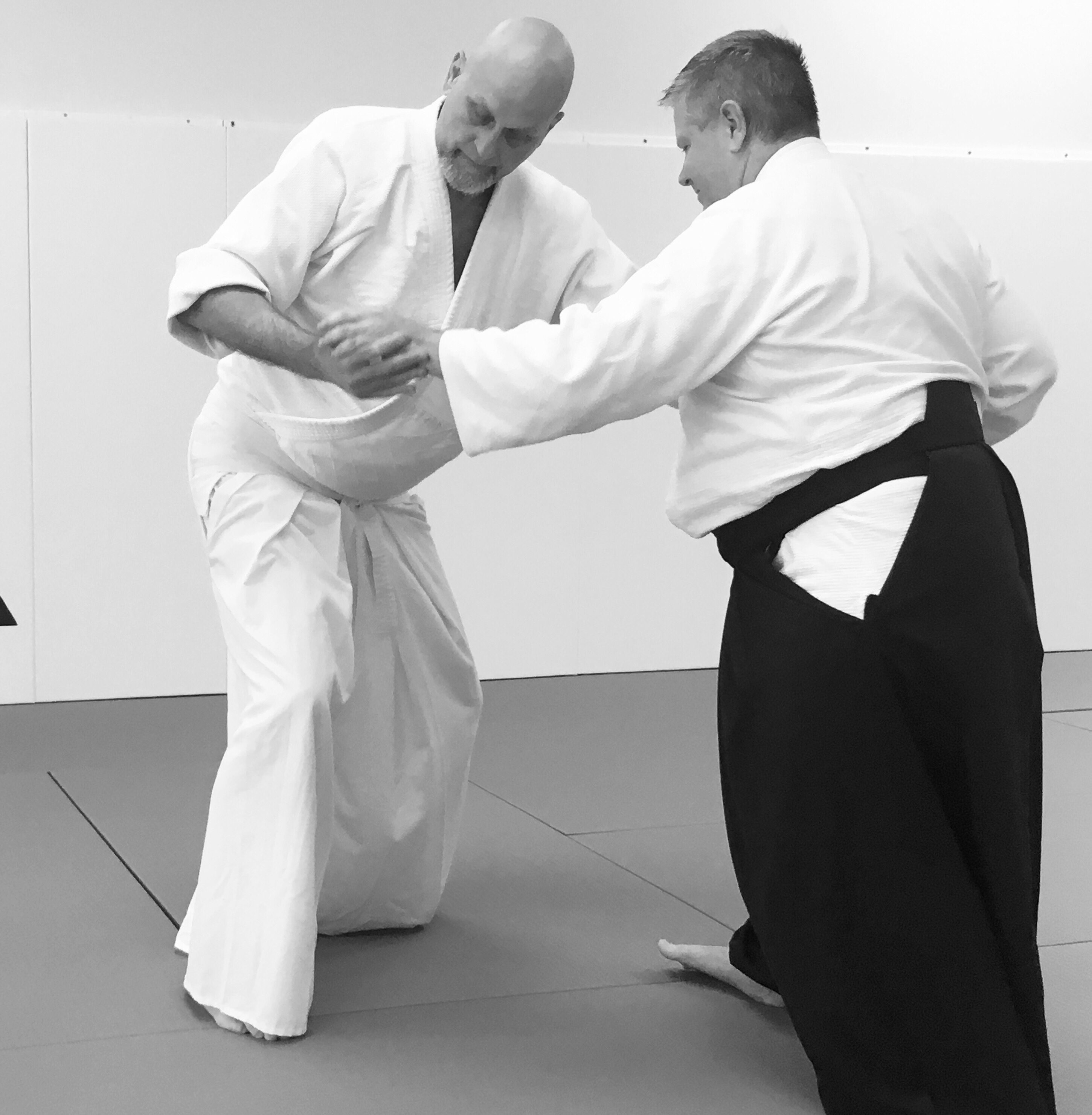
    As a movement theme, ikkyo becomes ikkyoku or movement patterns on a vertical plane: rising and falling. Nikyo becomes nikyoku, movements along a horizontal plane: side to side in a figure-8 pattern. Sankyoku are movements that spiral up and away from the body. Yonkyoku spirals down and toward the body. Gokyoku concentrates force to a single point, like a wedge. Another way of looking at these themes of movement is that they are planes one ‘finds oneself on’ during freestyle practice, with the natural and logical movement ‘presenting itself’ to tori. If thought of as positions on a clock face, ikkyoku is performed when one’s arms are at the one o’clock position, nikyoku at two, sankyoku at three, and yonkyoku at four o’clock, with gokyoku being applicable along at any position by cutting through resistance to a concentrated point of uke’s body.

    This framework, first presented to me by Budd Yuhasz a few months prior, revolutionized the way that I thought about the aiki-arts. I had always struggled with the idea of the aiki-arts being a ‘natural’ expression of universal physical principles because the way I was taught (originally in traditional Korean hapkido) was very ‘defensive’ and reactionary, meaning the attacker does some attack and I, the person practicing, responded with a specific pre-planned technique. The problem with this type of training was that there were simply too many techniques to choose from and, when presented with real, live resistance, like I experienced in Brazilian jiu-jitsu (BJJ), I was slow, almost paralyzed by having too many options and, by the time I picked which weapon in my vast arsenal to use, it was too late and I was already dying or dead.

    Amdur’s Taikyoku framework simplified things into five options, five shapes, each one being the most logical movement based on the physical geometry between both practitioners. Since each movement theme had a specific context within which it was most useful, there is only one ‘natural’ choice for how to respond and this makes the response faster and more ‘true,’ so that it is no longer a defensive reaction, but is the physical will of the practitioner and his or her body exerted along the most desirable pathway so that the technique becomes manifest on its own and is no longer slowed by cognition. If the will is always towards irimi (even when retreating or turning), and the body knows which shape to make next, based on where it finds itself, not reliant upon the body of uke, aikido (aikijujutsu or aiki-kempo) is what is happening not what I am trying to do to you. This is takemusu aiki, the natural and spontaneous expression of aiki. I was hooked.

    Along with this revelatory martial experience, this seminar also shifted my life for the better in another way because it was the first gathering of who would become the principals of the Taikyoku Mind & Body collective, for this is where Budd Yuhasz, Jevin Orcutt, and myself all shared the mats together for the first time with Ellis Amdur sensei. Budd and Jevin had been training brothers for years under Amdur’s guidance, but I had only just met Budd a few months prior. At Aikido of Pittsburgh, I met Jevin and we were all together for the fist time, an experience that laid the foundation for a lasting brotherhood and the martial collective we would eventually form. Taikyoku Aikido became Taikyoku Budo through Budd Yuhasz’s realization that Amdur’s principles, while being an ideal container for a personal internal strength practice (qigong), were also applicable in striking, grappling, and even weapons, whether within, or even transcending, any style or system. Through our connection, mutual interest, and sharing of ideas, Taikyoku Budo eventually became one aspect of the Taikyoku Mind & Body organization founded by Budd, Jevin, and myself.

    Here we are in 2019 and Aikido of Pittsburgh is hosting Ellis Amdur again this coming weekend for a three-day seminar, with Budd Yuhasz co-teaching an internal strength class on the third day. Since that seminar in 2014 a lot has changed, but some things remain constant. The Taikyoku weapon practice that Amdur has been working on with aikido and BJJ black belt Bruce Bookman has developed further to include both bokken (sword) and jo (staff) techniques. Amdur has also begun teaching ‘modules’ of Araki-ryu kata to a few different schools across the country, calling what he is showing Taikyoku Araki-ryu. Budd has continued to refine his internal strength practice to impressive results. Jevin has expanded his training beyond Taikyoku Budo to include both BJJ and Ono-ha Itto-ryu Sokaku Den, the sword style Takeda Sokaku is said to have practiced before developing Daito-ryu aikijujutsu. Along with my friend Dwayne Bowie and my brother, I opened my own dojo in Severna Park, MD called Kogen Dojo, a name inspired by Amdur sensei, where I teach both Taikyoku Budo and BJJ.

    This weekend’s seminar at Aikido of Pittsburgh will focus on Taikyoku Araki-ryu on Friday, Taikyoku aiki and weapons on Saturday, and internal strength for the aiki arts on Sunday, something Amdur has written about at length in his book Hidden in Plain Sight: Esoteric Power Training Within Japanese Martial Traditions. I am sure that the seminar will be amazing and is not to be missed.

    Related Links

    • Aikido of Pittsburgh
    • Ellis Amdur
    • Edgework Books (the writings of Ellis Amdur)
    • KogenBudo (the blog of Ellis Amdur)
    • Kogen Dojo
    • Taikyoku Araki-ryu
    • Taikyoku Mind & Body

    -Robert Van Valkenburgh teaches Taikyoku Budo and Brazilian Jiu-Jitsu at Kogen Dojo

    40.497933 -79.944157

    Share this:

    • Share on X (Opens in new window) X
    • Share on Facebook (Opens in new window) Facebook
    Like Loading…
    March 28, 2019
    aikido, araki-ryu, bjj, brazilian jiu-jitsu, budd yuhasz, edgework books, ellis amdur, hapkido, internal strength, japanese martial arts, kogen dojo, Martial Arts, taikyoku budo

  • Resist Temptation And Make Something You Are Proud Of

    What work are you doing that you are proud of?

    “There is no human being I can name who can point to a body of work on Twitter and say ‘I am proud of that.’ That means all that time was spent not building a body of work you were proud of and we ought to be doing that. There’s never been a better time to have an idea. There’s never been a better time to be a writer, a singer, a speaker, a podcaster. There’s never been a better time to figure out how to help people than right now, but instead we spend an hour watching cat videos.”

    –Seth Godin

    Recently, I found myself involved in multiple debates on social media. These were situations where I posted an article, a video, or a meme of a political nature and, in the comments section of my post, an argument ensued. Often, I was not even part of the argument, but I was a witness to it. This gave me pause and caused me to reflect. Is it worth it? Is it worth the time, the energy, and the conflict to be intentionally, or unintentionally, divisive on social media? Life is hard enough already, and we are disconnected enough from each other, from compassion and empathy for each other, that we do not need more things dividing us, especially on social media platforms that are specifically designed to do so, in order to keep our attention and feed the advertisers.

    What if I resisted temptation? What if opted not for instant notification-gratification and instead put my time and effort into something I was proud of, something that will (or won’t) pay off in the future? What if I invested in a creative project, something I am proud of and that my child can look at someday and be proud of, instead of in driving someone else’s political, financial, or personal agenda forward? What if I double-down on my creative passions, my writing, my martial art practice, and developing both myself and those around me as leaders? What if I gave more time and attention to my wife and my daughter? Our time is limited and it is shorter than we imagine. Do something worth doing. Make something worth making.

    -Robert Van Valkenburgh teaches Taikyoku Budo and Brazilian Jiu-Jitsu at Kogen Dojo

    Share this:

    • Share on X (Opens in new window) X
    • Share on Facebook (Opens in new window) Facebook
    Like Loading…
    March 27, 2019
    create something, creativity, family, make art, make something, Martial Arts, seth, seth godin, social media, writing

  • Love is a Request Undenied

    What would I have missed if I was not willing to pay attention?

    A few nights ago, as I was writing, my daughter walked past me to go to the bathroom. Less than a minute later, she came back and told me that the house was too dark and she was scared to go to the bathroom by herself. I reminded her that she is almost four and she knows how to turn the lights on. I told her how brave I know her to be and that I knew she could do it on her own. Still, she stood next to me and asked me to take her to the bathroom. She wanted me to carry her.

    As I picked her up, her little arms wrapped around me and I understood. She seemed heavier than the day before. She seemed taller and older than the last time I carried her, even if it was no more than twenty-four hours prior. She was growing up and my embrace could not slow it down. It was in that moment that I understood every request by this little girl to be with me was an honor that needed my attention. She needed my attention.

    I held her. I truly held her, knowing that this was life and it would be different in the blink of an eye. Soon, this moment I was allowed to have with her will no longer be a possibility or at least it will not be the same. For now, for as long as I can and for as long as she lets me, I will carry her wherever she asks and I will consider it a blessing to do so.

    -Robert Van Valkenburgh teaches Taikyoku Budo and Brazilian Jiu-Jitsu at Kogen Dojo

    Share this:

    • Share on X (Opens in new window) X
    • Share on Facebook (Opens in new window) Facebook
    Like Loading…
    March 26, 2019
    attention, childhood, daughter, family, fatherhood, growing up, life, love, opportunity, parenthood, parenting

Previous Page Next Page

Create a website or blog at WordPress.com

Loading Comments...

    • Subscribe Subscribed
      • Meditations on God
      • Join 270 other subscribers
      • Already have a WordPress.com account? Log in now.
      • Meditations on God
      • Subscribe Subscribed
      • Sign up
      • Log in
      • Report this content
      • View site in Reader
      • Manage subscriptions
      • Collapse this bar
    %d