Skip to content

Meditations on God

  • Robert Van Valkenburgh

  • Outsourcing A Single Leg Takedown

    If you do not know something, ask someone who does.
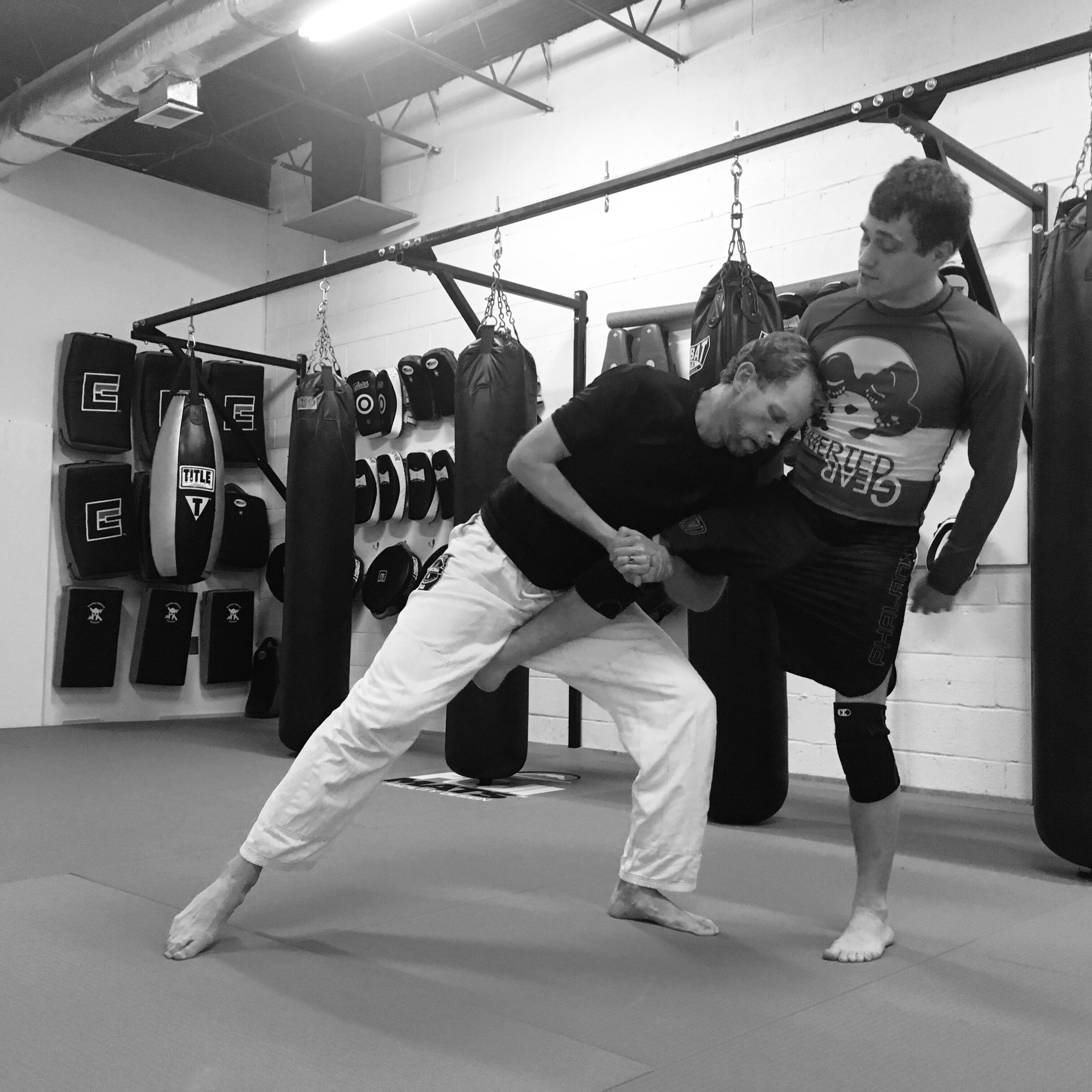
    The open source nature of the Taikyoku Budo framework allows us to draw information from various experts or journeymen from other martial arts. The information is then filtered through our core principles and integrated or pared away as appropriate, always looking to see what is useful and beneficial to our overall vision.

    Here we see John, a Taikyoku Budo practitioner, learning a single leg takedown from Tim who is a lifelong wrestler and a Brazilian Jiu-Jitsu student at Kogen Dojo. Tim is a great teacher and his ground-up approach to wrestling principles is eye-opening and immediately applicable to both sport grappling and a more self-defense based approach to training.

    A single-leg takedown is such a fundamental grappling move that several variations of it can be seen in Japan’s oldest grappling style, sumo wrestling, most obviously in the ashitori (leg take) technique. By looking into the past, at ancient arts like sumo, and comparing what is found with what is working in modern, competitive practices like wrestling or BJJ, we are able to keep one foot firmly rooted in tradition and the other moving forward in innovation.

    -Robert Van Valkeburgh is a practitioner of Taikyoku Budo and Brazilian Jiu-Jitsu at Kogen Dojo
    39.073857 -76.547111

    Share this:

    • Share on X (Opens in new window) X
    • Share on Facebook (Opens in new window) Facebook
    Like Loading…
    February 13, 2019
    bjj, brazilian jiu-jitsu, japanese martial arts, kogen dojo, Martial Arts, single leg takedown, submission grappling, sumo, taikyoku budo, wrestling

  • Spend Your ‘Yes’ Wisely

    There are different attitudes about scarcity in this world. Some believe that we live in a world of limited resources and, in order for one person to have something, another person must have without. Others believe that we live in a world of abundance and that there is more than enough to go around. Of course, there are those in the middle who believe that we live in a world of abundance, but that resources are simply not possessed or distributed evenly. Regardless of where one stands in this debate, one thing is certain. Time is a non-renewable resource and the way we spend our time is a zero sum equation. What is spent is gone and cannot be accrued again.

    When we are young, the world and its possibilities seem infinite. We spend our time blisfully unaware of its passing, except when we are forced to wait for something. What child wants to wait for anything? As a child, there is only the present and the infinite future. As we get older, however, we begin to measure our time in hours and minutes. Much of this is due to the fact that, as we begin working, the time we give away to our careers is rewarded with a paycheck. We begin to trade our time for money. We believe that lack of money is our problem and so we set out on a quest to make our time more and more valuable to others in the form of higher and higher hourly wages or salaries. What once seemed to be in infinite supply, our time, soon becomes more and more scarce and we find ourselves needing more of it to do what truly matters to us. Unfortunately, time spent or time lost is never regained.

    With every request or demand for our time, we have to decide whether or not this new thing is the most important thing in the world lest our time is literally wasted. That sounds rather dramatic, but it is a fact. Every moment is a decision to do that which matters most or that which matters least. There is no middle ground because that which does not matter most, since we can only do one thing in any given moment, by default is that which matters least. For every yes we say to a task, a project, a loved one, a phone call, our boss, a television show, a click on social media, we are saying no to all other things. Time is a zero sum equation. We do not get back what we spend. We can spend our time well or we can spend it poorly, so we must choose wisely how we use our ‘yes.’

    -Robert Van Valkenburgh teaches Taikyoku Budo and Gracie Jiu-Jitsu at Kogen Dojo

    Share this:

    • Share on X (Opens in new window) X
    • Share on Facebook (Opens in new window) Facebook
    Like Loading…
    February 13, 2019
    choice, choices, priorities, prioritizing, time

  • Quality, Satisfaction, and More

    One of the primary influential factors on our level of satisfaction is quality. When a product, service, or experience is of high relative quality, we tend to be more easily and long-lastingly satisfied by it. Conversely, if a product, service, or experience is of low relative quality, we tend to be less satisfied by it.

    Our minds are funny things, however. Often they trick us into believing that quantity can make up for quality and that a higher volume of low quality will somehow add up to the same level of satisfaction as a smaller volume of the same thing at a higher level of quality. This belief often causes us to bypass that which is of higher quality, and usually cost, for more of that which is of lower quality and lower cost. The problem is that no amount of low quality things added together will ever equal high quality, whether it is a product, service, or experience.

    Once we get a taste for high quality, low quality becomes even less satisfying, even off-putting or repellant. With this appetite for quality, we find ourselves struggling with a new challenge. Satisfaction becomes more elusive. We are not wired for satisfaction. We are wired for more. How do we overcome the desire, the need, for more?

    -Robert Van Valkenburgh teaches Taikyoku Budo and Brazilian Jiu-Jitsu at Kogen Dojo

    Share this:

    • Share on X (Opens in new window) X
    • Share on Facebook (Opens in new window) Facebook
    Like Loading…
    February 11, 2019
    almond croissant, coffee shop, food, pastry, quality, satisfaction

  • Osoto Gari as Iriminage

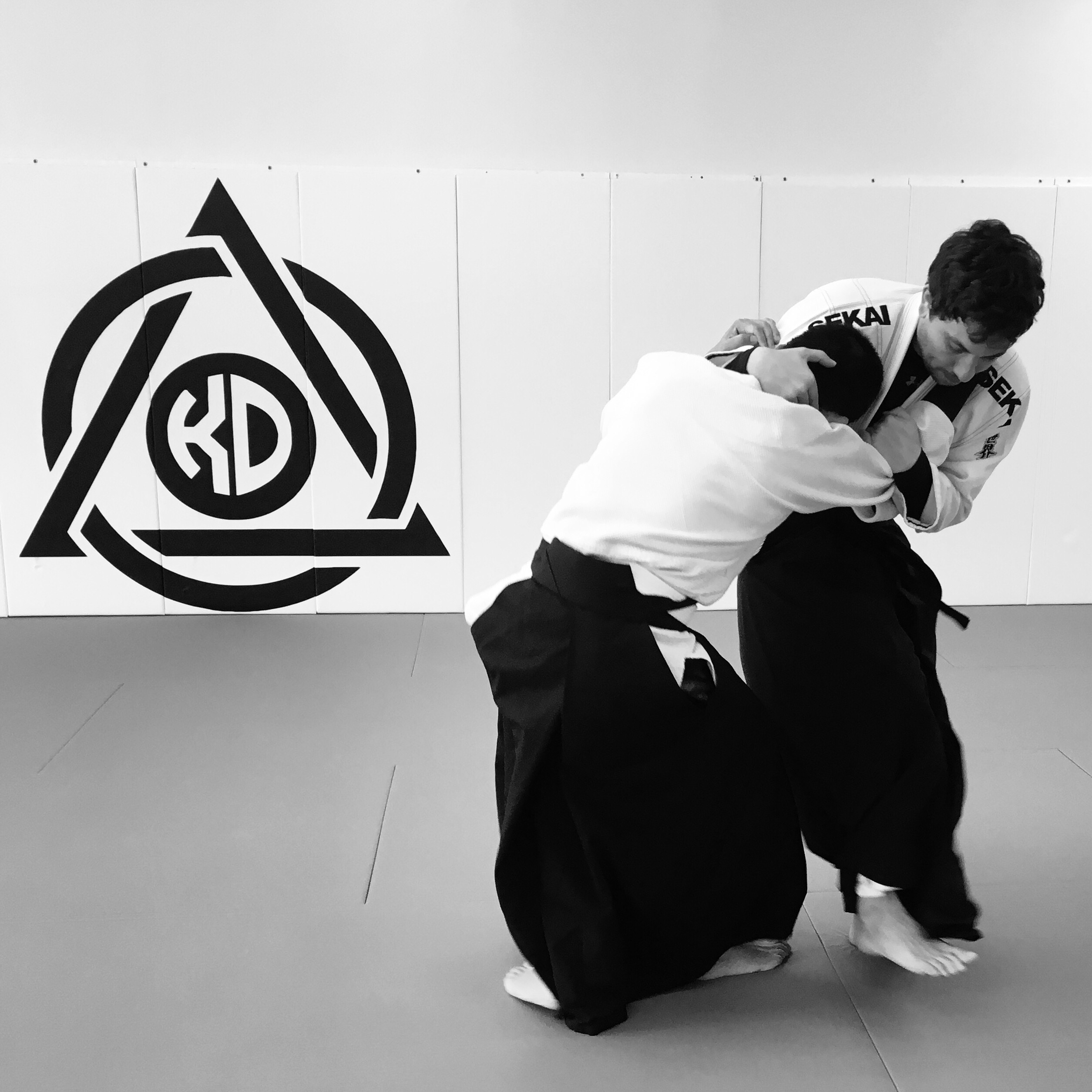
    Iriminage (entering body throw) is the quintessential Taikyoku Budo technique because every technique in Taikyoku Budo begins with irimi. Irimi is the principle of taking space, displacing one’s opponent’s body with one’s own.

    As Ellis Amdur explains, “As the enemy cuts, so, too, do I cut. Not ‘along’ the same path. ON THE SAME PATH. Two objects cannot occupy the same space, and I, with greater power/speed/timing/postural stability, etc, take that space. The enemy is, ostensibly, deflected, but they are NOT knocked away… This, by the way, is the true essence of atemi—not pugilism—but using the body (particularly the limbs) to take space the opponent is trying to occupy. ”

    Iriminage is a stylized throw that is the physical manifestation of this principle, but, with proper physical and mental organization, all body throws essentially become iriminage, ie a throw resultant from irimi.

    In this image, we see Reyadh applying osoto gari (large outer leg reap) on Paolo. One way to think about osoto gari is that it is iriminage with a leg sweep. This is especially useful when uke (the person receiving the throw) tries to counter tori (the person applying the throw) with irimi of his own, in this case by turning into tori and applying an underhook. The leg sweep is a great way to counter this counter, such that partners exchange irimi until one is finally thrown.

    -Robert Van Valkenburgh teaches Taikyoku Budo and Brazilian Jiu-Jitsu at Kogen Dojo

    39.073857 -76.547111

    Share this:

    • Share on X (Opens in new window) X
    • Share on Facebook (Opens in new window) Facebook
    Like Loading…
    February 11, 2019
    atemi, irimi, iriminage, japanese martial arts, judo, kogen dojo, Martial Arts, osoto gari, taikyoku budo

  • If You Want To Eat, Learn How To Cook

    Growing up, we rarely ever ate fast food. My mother cooked, my grandmothers cooked, and we had family dinner every night, with Sunday dinner and holiday dinners sometimes at my grandparents’ houses. That is not to say that we did not have junk food or snacks, but most of the food we ate was homemade. It is not something one really notices because normal is just normal to a kid, but I have fond memories of not only the dinners we had, but also of the cooking itself.

    Once I moved to Annapolis and began living on my own, I faced a dilemma. I did not want to eat fast food and I could not afford restaurant food. To my mind, canned, boxed, or other packaged foods were tantamount to fast food in that what is gained in convenience is lost in quality. I simply did not want to eat them, but a person needs to eat. Luckily, as a teenager, when my mother had to work late, she would leave instructions for me, telling me how to prepare dinner so that it was ready for her to serve when she got home. This experience gave me the confidence I needed to at least try to cook for myself.

    At the time, I was a vegetarian which limited my cooking options in a good way. It forced me to be creative within certain constraints. Essentially, I had to figure out how to combine a starch and an assortment of vegetables in a way that tasted good and allowed me to stay within my budget. I experimented with different combinations and found some recipes that I really liked. With these as a foundation, I could add, subtract, or substitute different ingredients into the recipes so that I had enough variety as to not get bored.

    The necessity to eat, combined with the desire to eat well and the confidence to experiment with different ingredients, recipes, and cooking methods within a restricted palette and budget, all resulted in my being a pretty good cook. If you think about it, that is not a bad recipe for success in life in general. Simply add necessity and desire with inspiration, a healthy set of constraints, and the willingness to fail until you get it right, and you are well on your way to something great.

    -Robert Van Valkenburgh teaches Taikyoku Budo and Brazilian Jiu-Jitsu at Kogen Dojo

    Share this:

    • Share on X (Opens in new window) X
    • Share on Facebook (Opens in new window) Facebook
    Like Loading…
    February 10, 2019
    cooking, culinary, Culinary Adventures, food, learning to cook, life lessons, Opinion, Personal Stories

Previous Page Next Page

Create a website or blog at WordPress.com

Loading Comments...

    • Subscribe Subscribed
      • Meditations on God
      • Join 265 other subscribers
      • Already have a WordPress.com account? Log in now.
      • Meditations on God
      • Subscribe Subscribed
      • Sign up
      • Log in
      • Report this content
      • View site in Reader
      • Manage subscriptions
      • Collapse this bar
    %d