It is easy to create something that no one else will ever see, hear, touch, or feel, to keep it to yourself where it is safe, where you are safe. Creation itself is easy. It only takes time. Putting your creation into the world and shining a light on it for others to see, that is an act of bravery and, whether others receive it as such or not, that is when it becomes art.
This does not mean that all creative projects should go public nor that all publicized creative works are works of art. It simply means that if you are hiding your work, your best work, you may be creative, but you are not (yet) an artist. This is not a condemnation. It is more of a plea. We need more artists. We need more creatives sharing their best work, the work they are most afraid of. We need more art in the world so that other creatives can be inspired to become artists.
Courage is contagious.
“As in life, so too in budo. As in budo, so too in life.”
-Robert Van Valkenburgh is co-founder of Taikyoku Mind & Body and Kogen Dojo where he teaches Taikyoku Budo and Brazilian Jiu-Jitsu
“The aiki-arts (aikido, aikijujutsu, hapkido, et al) are ineffective for fighting and incapable of teaching practitioners how to defend themselves against even the most inexperienced attacker, let alone a seasoned martial artist.”
John and Reyadh practicing tehodoki (hand releases) off of a collar tie.
As a practitioner of both aikido (one aspect of Taikyoku Budo) and Brazilian jiu-jitsu (BJJ), I have spent a lot of time contemplating this argument, trying to find my footing and discover my own truth and my own path. When in doubt, I feel it wise to refer back to the beginning and, for me, that means Takeda Sokaku.
Takeda Sokaku was the founder of Daito-ryu aikijujutsu, the parent art of aikido and (traditional) hapkido. Takeda grew up, like most kids of his era, sumo wrestling for fun. In his youth, he competed in many local sumo tournaments, against much larger, stronger wrestlers, and he often won. As he began studying more traditional grappling and weapon-based arts, Takeda traveled around Japan, visiting various dojo and taking part in challenge matches to test his skills. Even after he developed and began teaching Daito-ryu aikijujutsu, he continued to practice sumo, informally sparring with his students before or after teaching.
Daito-ryu aikijujutsu itself did not formally incorporate sparring, however. Obviously, Takeda was not opposed to either randori (friendly inner-dojo sparring) or shiai (inter-dojo competitive bouts). He did both (maybe we should also). Why then is there no randori or shiai in Daito-ryu aikijujutsu or other aiki-arts in the way we see it in BJJ for example? Perhaps it was not meant for that. Maybe it was intended to teach its practitioners something different, something that would translate to grappling, striking, or weapons and would make the practitioner more effective in randori or shiai within these contexts, but which is not itself intended to be for ‘fighting.’ That would also explain why the aiki-arts, in their outer form, do not appear to lend themselves well to sparring or competition. They are not supposed to and that is okay.
“As in life, so too in budo. As in budo, so too in life.”
-Robert Van Valkenburgh is co-founder of Taikyoku Mind & Body and Kogen Dojo where he teaches Taikyoku Budo and Brazilian Jiu-Jitsu
“Insanity is doing the same thing over and over again and expecting different results.”
-Anonymous
“There’s a fine line between genius and insanity.”
-Oscar Levant
“You can tell the amateur from the professional musician simply by listening to him practice. The amateur attempts to play the whole song over and over again, never really improving. The professional plays until he hits the wrong note, stops, and repeats that phrase or passage until it is perfect. Only then will he move on to the next phrase or passage in the song. To the untrained ear, the professional’s practice sounds a lot like noise.”
-Robert Mondelli (my grandfather)
Pictured: Coach Bowie helping John make micro-adjustments to his knee-on-belly pin by attacking the openings.
Genius then, is the ability to do the same thing over and over again, making micro-adjustments each time, until a breakthrough is had and new results are gotten. Persistence alone does not produce genius-like results. Intelligent persistence does. One must know when to push forward, when to pause, when to pivot, and when to back up to reevaluate and push forward in a new way.
“As in life, so too in budo. As in budo, so too in life.”
-Robert Van Valkenburgh is co-founder of Taikyoku Mind & Body and Kogen Dojo where he teaches Taikyoku Budo and Brazilian Jiu-Jitsu
Are you building a foundation of trust and hope or are you filling your pockets with bricks?
A business is a lot like a building and the founders or owners are the architects, builders, and designers. They must ask themselves what they want to build, why, and for whom. Is it going to be a structure built with generosity and forethought, something strong and long-lasting that can house and feed a community, that will stand tall as a beacon to those looking for shelter and hope, and that can withstand the storms that will inevitably test its integrity, or is it going to be flimsy and weak because the founders are hoarding every brick, filling their pockets and leaving others to fend for themselves against the elements?
“As in life, so too in budo. As in budo, so too in life.”
-Robert Van Valkenburgh is co-founder of Taikyoku Mind & Body and Kogen Dojo where he teaches Taikyoku Budo and Brazilian Jiu-Jitsu
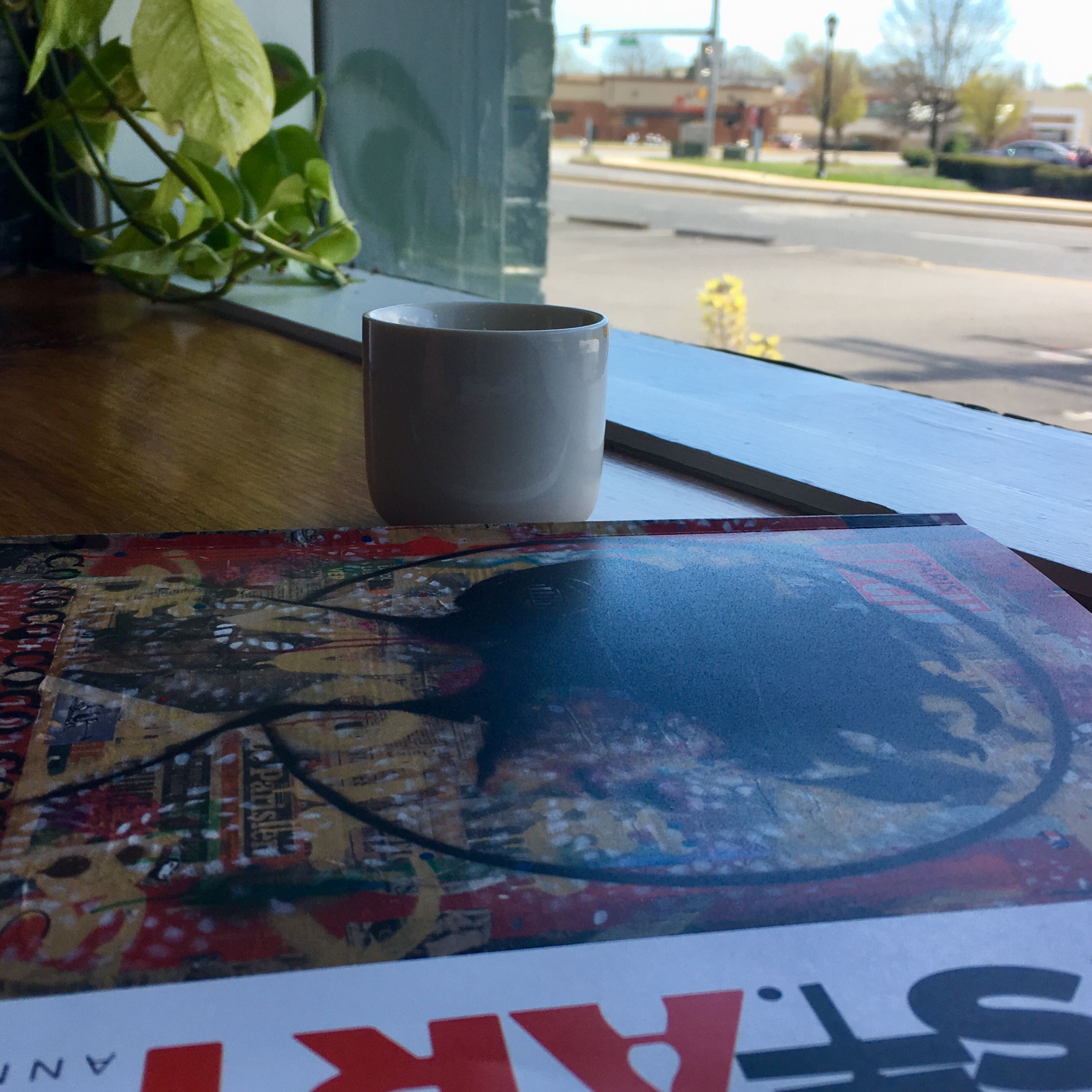
Espresso and UpStArt Mag at Rise Up Coffee in Annapolis
For the past twenty plus years, I have worked in and around coffee shops. I have held every position from barista to manager to espresso-machine technician. In all of that time, I have tried nearly every kind of coffee-drink combination a person can imagine. I tried different syrup, milk, and coffee combinations. For a while, it was fun. Eventually, however, the novelty wore off. I got bored and none of the ‘fancy’ drinks I made for myself really tasted good anymore.
At this point, I decided to get back to basics and I began drinking plain espresso and brewed coffee. Strangely, once I limited my options in this way, I found that I was much more content and could actually begin exploring and enjoying the depth and variety of the actual coffee. I realized that I preferred simplicity and quality over variety and quantity. I just liked coffee. Even more specifically, I discovered exactly which coffee I enjoyed most and which I could do without.
As I reduced my options, my palate developed and my personal tastes began to reveal themselves. Coffee from every coffee-growing region all has a unique flavor profile. Whether it is from Latin America, Africa, Asia, or the Middle East, a coffee’s flavor, mouthfeel, and body are defined by how and where it is grown, how it is dried and roasted, and how it is brewed. None of this mattered when I drank a 20oz caramel soy-latte, but by choosing to not drink that (also delicious) drink or others like it, I discovered that it matters to me.
“As in budo, so in life. As in life, so in budo.”
-Robert Van Valkenburgh is co-founder of Taikyoku Mind & Body and Kogen Dojo where he teaches Taikyoku Budo and Brazilian Jiu-Jitsu