Skip to content

Meditations on God

  • Robert Van Valkenburgh

  • Fundamentals: A Prescription for Preempting Attack

    When my brother first came back from Thailand, he caught me with the same arm-bar for three months straight until I started to recognize the setup. Once I recognized the setup and learned to block it, he began arm-barring my other arm.
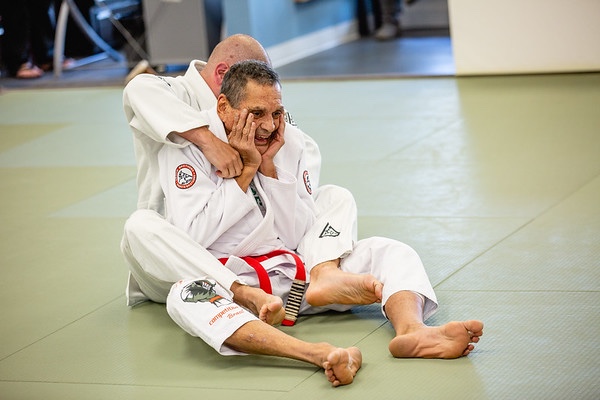
    Relson Gracie showing a principle-based back mount defense at Kogen Dojo. Photo by Mike Oswald Photography

    One skill we develop as we train in martial arts is the ability to recognize that certain cues from our training partners correlate to specific threats. Over time, our bodies become more intelligent in this regard and we begin to recognize, either physically or subconsciously, micro-movements or even shifts in intention and what were once slow, clunky reactions, become more agile and fluid, even shutting down the threat before it arises.

    The reality is, however, that not only are our partners also learning, evolving, and adapting, but new, different training partners come along, with different skills and goals than what we are accustomed to. Now, we find that the cue we thought represented a specific threat was actually a trick to set up an entirely different attack. In this way, so-called ‘muscle memory’ can actually become a hindrance, leading us into traps instead of getting us out of them.

    The best way to respond to a threat is not to anticipate it in order to react to it. Instead, we should position ourselves in such a way as to always have the initiative, even in defense. This requires us to understand fundamental principles of attack and defense that are universal instead of specific. With these principles as our foundation, the type of threat we face and the form it takes becomes less important and we can be less reactionary. The fundamentals may seem boring or unimpressive in the beginning. However, with enough focus and repetition, they actually offer us the freedom to explore higher, more sophisticated skills later, more safely and with more longevity.*

    “As in life, so too it is in budo. As in budo, so too it is in life.”

    -Robert Van Valkenburgh is co-founder of Taikyoku Mind & Body and Kogen Dojo where he teaches Taikyoku Budo and Brazilian Jiu-Jitsu

    *Note: This post was inspired by a recent series of seminars that I attended which were taught by Relson Gracie black belt Todd Tanaka who runs Relson Gracie Jiu-Jitsu Team HK in Hawaii
    39.073857 -76.547111

    Share this:

    • Share on X (Opens in new window) X
    • Share on Facebook (Opens in new window) Facebook
    Like Loading…
    June 30, 2019
    bjj, brazilian jiu-jitsu, budo, fundamentals, gracie jiu-jitsu, japanese martial arts, kogen dojo, life, Martial Arts, taikyoku budo

  • Rank is a Symbol (Not a Right)

    There is more to rank in martial arts than skill (and loyalty) alone.

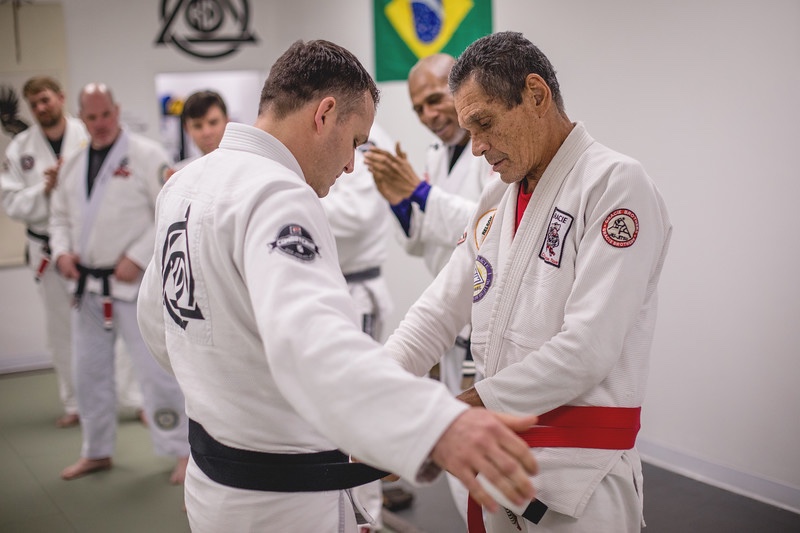
    Ike Haertel receiving his black belt from Relson Gracie at Kogen Dojo: Photo by Mike Oswald Photography

    In martial art competition, rank is important as a means of establishing a level playing field. It is also important as a symbol of who is capable of teaching new students and to what degree. Aside from that, I have often thought that belt ranks in martial arts are somewhat silly. Recently, however, I have been reflecting on this and, at least when it comes to the higher level ranks, specifically that of the black belt instructor, I have come to a different conclusion.

    At the Brazilian jiu-jitsu (BJJ) school where I started, there was a guy who would drop in over the years and, in spite of the time between visits, he was always the same rank. Our teacher told us that he had been that rank for nearly a decade. Every time he came in, every roll (sparring round) was like a grudge match. He tried to submit everyone as hard and fast as possible, even if it hurt them, and he refused to tap when defeated, even if it meant being choked unconscious. He helped me measure my progress, but rolling with him was definitely not for everyone and his presence was not really good for the school. In fact, it was a distraction.

    One day, another student asked our teacher, “How come after all of these years, even though [the visitor] is obviously skilled, he is still a purple belt?” To that, our teacher replied, “He has been jumping around from school to school for years. He has no loyalty. Who is going to promote him?” This made sense to me at the time, but I think there is more to it than that.

    Loyalty and skill are obviously important in a competitive team environment, but loyalty is a two-way street and skill is often relative to the environment and the person. What is more important, at least at higher ranks, is whether or not the person is actually good for the school, for the team in general. When I think about the best black belt instructors I know, the ones who truly embody the rank and title, they are also leaders, and leadership, true leadership, is never selfish.

    “As in life, so too it is in budo. As in budo, so too it is in life.”

    -Robert Van Valkenburgh is co-founder of Taikyoku Mind & Body and Kogen Dojo where he teaches Taikyoku Budo and Brazilian Jiu-Jitsu

    39.073857 -76.547111

    Share this:

    • Share on X (Opens in new window) X
    • Share on Facebook (Opens in new window) Facebook
    Like Loading…
    June 28, 2019
    altruism, bjj, black belt, brazilian jiu-jitsu, budo, gracie jiu-jitsu, japanese martial arts, kogen dojo, leadership, life, loyalty, Martial Arts, rank, selfishness, service, taikyoku budo

  • Your Time Deserves My Attention

    Deep, meaningful relationships begin with a commitment to be present.

    Many years ago, I was dating a girl for a brief time. One day, she approached me and said, “A guy I used to go out with asked me if I wanted to have dinner with him sometime to catch up. Would you mind if I went?” I paused for a moment to reflect. We hadn’t been together for very long and our relationship was still fairly casual. “You are free to do whatever you want and to see whomever you’d like,” I replied. She looked somewhat relieved, but puzzled. I continued, “Just do not expect me to be here when you get back.”

    The problem, as I saw it, was not that she wanted to see other people. She had every right to do so and I had no right to try to stop her. I knew, however, that I did not want to be with someone who wanted to see other people.

    Imagine we are at a party, having a conversation, and the whole time I am looking around the room for someone else to talk to. How much of yourself can you, or should you, share with me? Life is too short to spend with people who are constantly looking past you to the next thing. We each deserve to be the destination for someone, not merely a stepping stone to something perceived as better.

    Our relationship is my promise to not look for someone or something else as long as we are together. Not everyone feels that way. I am only interested in spending time with those who do.

    “As in life, so too it is in budo. As in budo, so too it is in life.”

    -Robert Van Valkenburgh is co-founder of Taikyoku Mind & Body and Kogen Dojo where he teaches Taikyoku Budo and Brazilian Jiu-Jitsu

    Share this:

    • Share on X (Opens in new window) X
    • Share on Facebook (Opens in new window) Facebook
    Like Loading…
    June 27, 2019
    attention, budo, dating, life, monogamy, partnership, relationships, sharing, time

  • Fundamentals for the Soul

    “There is a sushi chef in Japan who has made maybe the same forty cuts of sushi for seventy years and he’s still trying to get it right. There is a guy in Spain who does nothing but grill stuff and that’s where all of the chefs want to eat. Very straightforward, very soulful food that’s do devoid of bullshit. No tricks.“

    – Anthony Bourdain

    Grilled sausages at the international market in Paris, France

    Fads and trends come and go. New tricks and new technology come in and out of favor. Rising stars gain the public’s attention and affection. Beneath all of this, however, behind the scenes and away from the spotlight, remains a constant, unwavering truth. The refined basics, the fundamental skills and techniques of any creative endeavor, never go out of style. They are the basics, they are the fundamentals, because they work, because they are true.

    When you experience this truth, whether it be in food, music, art, or in martial arts, it is undeniable, eye opening, soul satisfying. It is life altering. This is Holistic Budo.

    “As in life, so too it is in budo. As in budo, so too it is in life.”

    -Robert Van Valkenburgh is co-founder of Taikyoku Mind & Body and Kogen Dojo where he teaches Taikyoku Budo and Brazilian Jiu-Jitsu

    Share this:

    • Share on X (Opens in new window) X
    • Share on Facebook (Opens in new window) Facebook
    Like Loading…
    June 26, 2019
    anthony bourdain, basics, budo, Culinary Adventures, culinary arts, food, foodie, fundamental truths, fundamentals, grilled meat, life, no reservations, parts unknown, sushi, truth

  • A Creative Death is the Antidote for a Practical Life

    New ideas are inherently impractical. We cannot change the world by doing what has already been done.

    ‘The Octopus’ by Ana

    Practicality is conforming to the status quo. It is not rocking the boat. It is following the well-worn path and not risking a detour that may lead to a dead end. It is low risk with low yield, over a long period of time. Practicality is the avoidance of failure and the result is the dull pain of a slow, quiet death.

    Creativity is the opposite of practicality. Creativity is the embracing of failure, not safety, because the more creative work a person does, the more he or she will fail, but failure is fuel for the creative process. Failure forces the creative person to problem-solve in new, unusual ways. Creative work is rewarded by embracing failure, not by avoiding it because failure is the incentive to do more, better creative work until the problem is no longer a problem.

    Creativity requires us to constantly take risks. It requires us to put ourselves on the line, to risk our ideas, our lives, and our status. It requires us to live and die over and over again each day, with no promise for any payoff except that, through our work, we get to live again and die again tomorrow. Creativity is the act of risking it all and living out loud, even if it kills us because a thousand little creative deaths are better by far than a long life of practicality and regret.

    “As in life, so too it is in budo. As in budo, so too it is in life.”

    -Robert Van Valkenburgh is co-founder of Taikyoku Mind & Body and Kogen Dojo where he teaches Taikyoku Budo and Brazilian Jiu-Jitsu

    Share this:

    • Share on X (Opens in new window) X
    • Share on Facebook (Opens in new window) Facebook
    Like Loading…
    June 25, 2019
    art, artist, budo, creation, creative, creativity, failure, life, pracitcality, the journey, the obstacle is the way, the path, the way

Previous Page Next Page

Create a website or blog at WordPress.com

Loading Comments...

    • Subscribe Subscribed
      • Meditations on God
      • Join 270 other subscribers
      • Already have a WordPress.com account? Log in now.
      • Meditations on God
      • Subscribe Subscribed
      • Sign up
      • Log in
      • Report this content
      • View site in Reader
      • Manage subscriptions
      • Collapse this bar
    %d