“If you don’t prioritize your life, someone else will.” —Greg McKeown from ‘Essentialism: The Disciplined Pursuit of Less’
In times of confusion and difficulty, often the only things we have to fall back on are our principles, our beliefs, and those things we hold to be most essential in our lives. While it is in times of trial and hardship that these become most apparent, it is in the good times, in the times of plenty, when our options are many, that we should contemplate and prioritize what is most important to us lest we find ourselves distracted by choices and possibilities unable to decipher what is essential from what is not.
When things are going well, we should always take a moment to step back and ask ourselves what of the things we have now we can live without. If we can learn to do this during the good times, doing so during the bad times will not be as difficult. We must all know for ourselves what is essential to our survival, our well-being, and our quality of life versus what is simply desirable and pleasurable.
By focusing on what matters most to us, even when we have everything, we will have more clarity when we experience loss. Without knowing this truth about our lives, it may be determined for us at some point by misfortune, unforeseen circumstances, or other people’s choices. It is infinitely better to choose to live with less when we can than to not know how to live with less when we must.
Holistic Budo: As it is in budo, so too it is in life. As it is in life, so too it is in budo.
Robert Van Valkenburgh is co-founder of Taikyoku Mind & Body and Kogen Dojo where he teaches Taikyoku Budo and Brazilian Jiu-Jitsu.
All photos by Robert Van Valkenburgh (artist unknown, unless otherwise noted).
If you found this post helpful or meaningful in some way, please feel free to Share, Comment, and Subscribe below.
We often have a tendency to overcomplicate things simply because it makes us feel more useful. If we have more to do, we feel like we have purpose. So, we spend a lot of time and effort creating more for ourselves to do.
What if, instead, we put that same effort and energy into simplifying our lives in such a way that we actually have less to do? Isn’t this where freedom is found, in having less to do and having more time? Time, after all, is the only non-renewable resource we have. Shouldn’t that be what we are working to have more of, instead of working to create more work?
Our goal should be to simplify where we can, to reduce complexity wherever possible. Some problems in life are naturally complex and difficult in their very nature. By simplifying other areas of our lives, we can face and solve the these truly complex and truly difficult challenges with more focus, clarity, and fewer distractions.
Holistic Budo: As it is in budo, so too it is in life. As it is in life, so too it is in budo.
“One of the secrets to success is not unbound freedom, but selecting the proper constraints.”
— Tim Ferriss
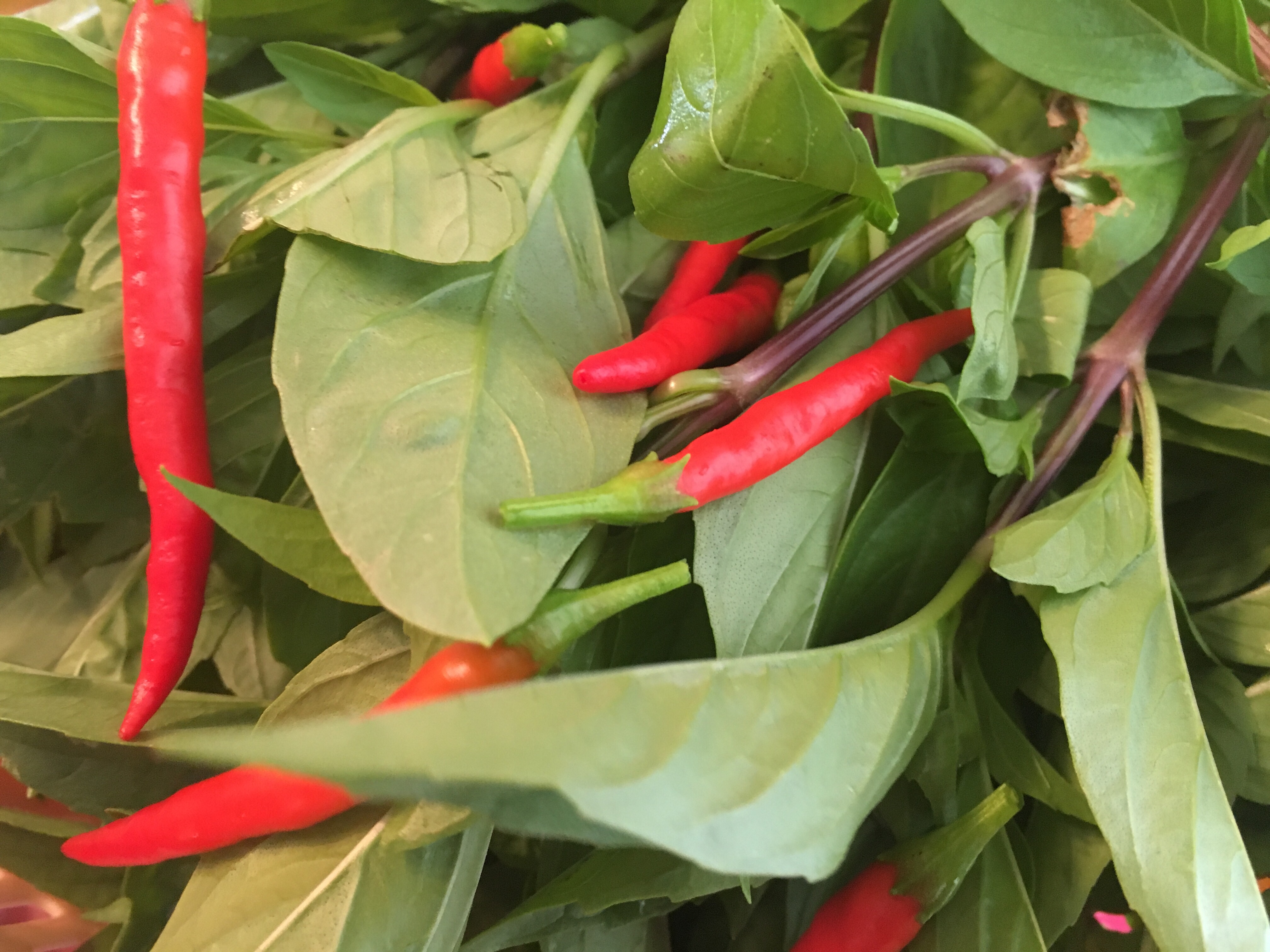
Homegrown Thai Basil and Bird Chilis
Being a husband, father, employee, and business owner, I have to make a lot of decisions every day. All decisions requires some degree of time, energy, and attention, each of which is in limited supply. Added decisions when it comes to things like what to cook and eat, especially when the options are seemingly infinite, take focus and energy away from other aspects of my life that are more important and making no decision at all means eating poorly, which only makes everything else, my health, my sleep, and my attitude, worse.
By applying a simple framework to cooking, inspired by Samin Nosrat, we can have variety without having to make a bunch of unnecessary decisions. If we think about the flavor of every dish as being the result of four components — salt, fat, acid, and heat — and we adjust those components, sourcing them from a specific culinary region, adding some regional herbs and alliums for an extra kick if we like, we give ourselves the luxury of infinite flavor options, without having to make an infinite number of decisions along the way.
Applying this framework to a simple piece of flank steak, we can make a Southeast Asian beef salad by pan searing (heat) the beef in avocado oil (fat), slicing it thin, and tossing it in a dressing of fish sauce (salt), lime juice (acid), and bird chilis (more heat). If we were to use sea salt, olive oil, balsamic vinegar, and red chili flakes, the same exact piece of beef becomes Italian. Soy sauce, sesame oil, rice vinegar, ginger, garlic, and scallions gives a Japanese flavor to the beef.
Looked at in this way, we do not need to make a lot of choices. We only need to choose a culinary region, allowing the region to tell us what salt, fat, acid, and heat works best for the protein and/or vegetables that are local and fresh.
By working inside these constraints, we are not only guaranteed to have fewer culinary decisions to make, but we are also promised a delicious outcome that is only restricted by availability and imagination.
“As in life, so too it is in budo. As in budo, so too it is in life.”
-Robert Van Valkenburgh is co-founder of Taikyoku Mind & Body and Kogen Dojo where he teaches Taikyoku Budo and Brazilian Jiu-Jitsu
Espresso and UpStArt Mag at Rise Up Coffee in Annapolis
For the past twenty plus years, I have worked in and around coffee shops. I have held every position from barista to manager to espresso-machine technician. In all of that time, I have tried nearly every kind of coffee-drink combination a person can imagine. I tried different syrup, milk, and coffee combinations. For a while, it was fun. Eventually, however, the novelty wore off. I got bored and none of the ‘fancy’ drinks I made for myself really tasted good anymore.
At this point, I decided to get back to basics and I began drinking plain espresso and brewed coffee. Strangely, once I limited my options in this way, I found that I was much more content and could actually begin exploring and enjoying the depth and variety of the actual coffee. I realized that I preferred simplicity and quality over variety and quantity. I just liked coffee. Even more specifically, I discovered exactly which coffee I enjoyed most and which I could do without.
As I reduced my options, my palate developed and my personal tastes began to reveal themselves. Coffee from every coffee-growing region all has a unique flavor profile. Whether it is from Latin America, Africa, Asia, or the Middle East, a coffee’s flavor, mouthfeel, and body are defined by how and where it is grown, how it is dried and roasted, and how it is brewed. None of this mattered when I drank a 20oz caramel soy-latte, but by choosing to not drink that (also delicious) drink or others like it, I discovered that it matters to me.
“As in budo, so in life. As in life, so in budo.”
-Robert Van Valkenburgh is co-founder of Taikyoku Mind & Body and Kogen Dojo where he teaches Taikyoku Budo and Brazilian Jiu-Jitsu



 Meditations on God