There is more to rank in martial arts than skill (and loyalty) alone.
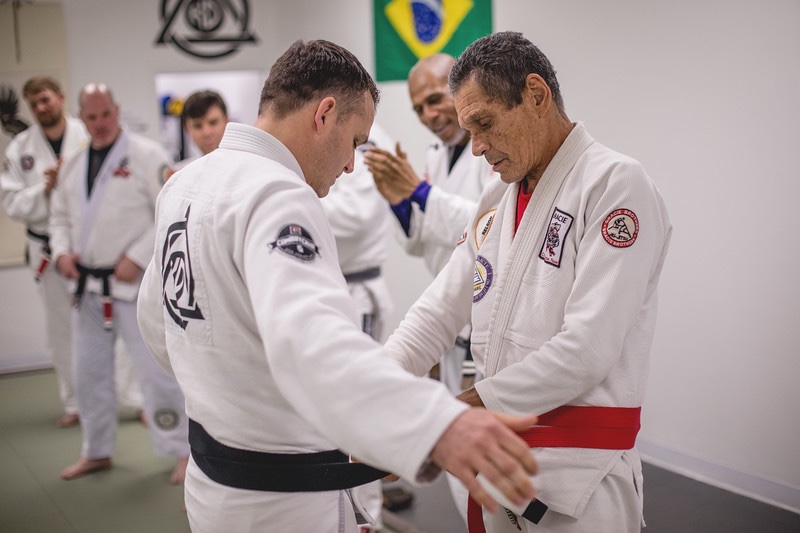
Ike Haertel receiving his black belt from Relson Gracie at Kogen Dojo: Photo by Mike Oswald Photography
In martial art competition, rank is important as a means of establishing a level playing field. It is also important as a symbol of who is capable of teaching new students and to what degree. Aside from that, I have often thought that belt ranks in martial arts are somewhat silly. Recently, however, I have been reflecting on this and, at least when it comes to the higher level ranks, specifically that of the black belt instructor, I have come to a different conclusion.
At the Brazilian jiu-jitsu (BJJ) school where I started, there was a guy who would drop in over the years and, in spite of the time between visits, he was always the same rank. Our teacher told us that he had been that rank for nearly a decade. Every time he came in, every roll (sparring round) was like a grudge match. He tried to submit everyone as hard and fast as possible, even if it hurt them, and he refused to tap when defeated, even if it meant being choked unconscious. He helped me measure my progress, but rolling with him was definitely not for everyone and his presence was not really good for the school. In fact, it was a distraction.
One day, another student asked our teacher, “How come after all of these years, even though [the visitor] is obviously skilled, he is still a purple belt?” To that, our teacher replied, “He has been jumping around from school to school for years. He has no loyalty. Who is going to promote him?” This made sense to me at the time, but I think there is more to it than that.
Loyalty and skill are obviously important in a competitive team environment, but loyalty is a two-way street and skill is often relative to the environment and the person. What is more important, at least at higher ranks, is whether or not the person is actually good for the school, for the team in general. When I think about the best black belt instructors I know, the ones who truly embody the rank and title, they are also leaders, and leadership, true leadership, is never selfish.
“As in life, so too it is in budo. As in budo, so too it is in life.”
-Robert Van Valkenburgh is co-founder of Taikyoku Mind & Body and Kogen Dojo where he teaches Taikyoku Budo and Brazilian Jiu-Jitsu
Sometimes, the needs of the business take priority over our personal interests.
Some time ago, in my first year as a General Manager (GM) for a large coffee company, I was at a development meeting with my District Manager (DM) and we were discussing labor and scheduling. He observed that I had several part-time employees on staff and questioned why I did not instead have one full-time employee in their place. We offered full benefits to both part-time and full-time employees so there was really no cost savings to hire part-time employees. His concern was that we could better serve an employee with full-time hours than part-time and that we might lose good workers if they did not get enough hours.
I explained that I had hired a young, female employee, in her early twenties, who was working full-time, but that she had recently changed her availabilty to part-time, just over twenty hours a week. This caused me to hire another young part-time worker to fill in the hours that the original employee was no longer available for. The result was two part-time employees where one full-time employee used to be. This concerned my DM for two reasons. First, he questioned why an employee would intentionally reduce her hours from full-time to part-time. Secondly, we were now paying full benefits to two people, doubling our cost, for a position that could be filled by one person. He asked me why the original employee had limited her availability. I did not know.
My DM asked me to call the young female employee over to where we were sitting in the cafe. When she arrived at our table, he introduced himself to her, invited her to sit down, and then he chatted with her for a while, easing the tension. Eventually, he got to the question at hand and asked her, “Why did you reduce your availabilty to only twenty hours a week?” “I have another job,” she replied. “What is your other job,” my DM inquired. “I work in a hair salon in the evenings,” she told him and then continued, “This isn’t my real job. I want to be a hair stylist.” “Oh, I see,” he replied, “Well, this is my real job. I hope you understand that we would prefer to give your hours to someone who feels the same way.”
-Robert Van Valkenburgh teaches Taikyoku Budo and Brazilian Jiu-Jitsu at Kogen Dojo

 Meditations on God