Training for mutual welfare and benefit (自他共栄 jita kyōei).
Jigoro Kano, the founder of judo, did much to revolutionize Japanese martial arts. From older, more violent martial systems, Kano compiled the techniques that were both safe for everyday training and most effective in randori (sparring). His goal was to create a system of physical and moral development for everyday Japanese people, especially for the youth. The result was a martial art that lives on to this day as one of the most popular and widely practiced in the world.
An educator and an idealist, Kano began with principles and valued and created the system of judo based on these. One of Kano’s principles was that judo should be practiced for mutual welfare and benefit. In the older systems (koryu), there was a strong sense of group development within the individual ryu, but other schools and systems were seen as enemies. Through judo, Kano wanted to transcend this clan-like mentality and give people a way to practice and a competitive outlet through which they could train and improve together, not just for the betterment of an individual or a particular group, but for everyone, including society as a whole.
Training for mutual welfare and benefit means that practitioners train in a way that both keeps everyone safe and makes everyone stronger. This means not only training in such a way as to avoid injuries, but also in such a way that is cooperative and purposeful. There is no room for selfish egoism in this kind of environment because the practice is all that matters. Not only does this make practitioners better martial artists, but it also creates lifelong bonds and friendship among all involved.
-Robert Van Valkenburgh teaches Taikyoku Budo and Brazilian Jiu-Jitsu at Kogen Dojo
Angle and positioning: How do we get there from here?
Anyone who has trained a martial art with resistance-based pressure testing or sparring knows that the correct technique in a given situation is rarely predetermined. A boxer may have a plan to knock out his opponent with his powerful right cross, but making perfect contact with perfect timing and placement is very difficult. The other boxer and his or her body has a say in the matter as well because he or she is fighting back and not all things work on all people. The same goes for a wrestler’s takedowns, a judoka’s throws, and a Brazilian jiu-jitsu practitioner’s submissions. The fighter may have a game-plan and a best move, but things change and he or she must adapt and overcome.
Training that focuses on a single technique as an inevitable pre-determined outcome to a given scenario, with no contingencies or alternatives for when, not if, things go sideways, is not only unrealistic but maybe even counterproductive. There are many better ways to train than this, with a variety of different focal points for the training. One useful method is to focus on repeatedly attaining an advantageous angle and positional advantage without concerning oneself with the takedown, pin, or submission, at least at first.
If you are able to consistently get to a dominant position, at the correct angle, under greater and greater amounts of stress and reisistance, application of the finishing technique becomes much easier. Angle and position give us the gift of time. They allow us to make tactical choices under significantly less pressure and threat of retaliation because, ideally, they put us out of harm’s way, even if for a brief moment. Angle and position stack the deck in our favor and give us greater control of the fight and its outcome.
So, next time you are practicing an armbar, a takedown, a choke, or ude osae (ikkyo), pause in the final moment prior to execution and reflect. Analyze the angling of your body and the position you are in relative to your partner. What does it look and feel like? How could it be better and more secure? How can you replicate that and find that place from anywhere? With this focus, you will fail at executing the finishing move for a while, especially in randori, but eventually you will find your groove and you will notice yourself fitting into that place more and more naturally until you begin to feel unstopable to your opponents who are still concerned with minutiae and not the big picture of angle and positioning.
-Robert Van Valkenburgh teaches Taikyoku Budo and Brazilian Jiu-Jitsu at Kogen Dojo
Iriminage (entering body throw) is the quintessential Taikyoku Budo technique because every technique in Taikyoku Budo begins with irimi. Irimi is the principle of taking space, displacing one’s opponent’s body with one’s own.
As Ellis Amdur explains, “As the enemy cuts, so, too, do I cut. Not ‘along’ the same path. ON THE SAME PATH. Two objects cannot occupy the same space, and I, with greater power/speed/timing/postural stability, etc, take that space. The enemy is, ostensibly, deflected, but they are NOT knocked away… This, by the way, is the true essence of atemi—not pugilism—but using the body (particularly the limbs) to take space the opponent is trying to occupy.”
Iriminage is a stylized throw that is the physical manifestation of this principle, but, with proper physical and mental organization, all body throws essentially become iriminage, ie a throw resultant from irimi.
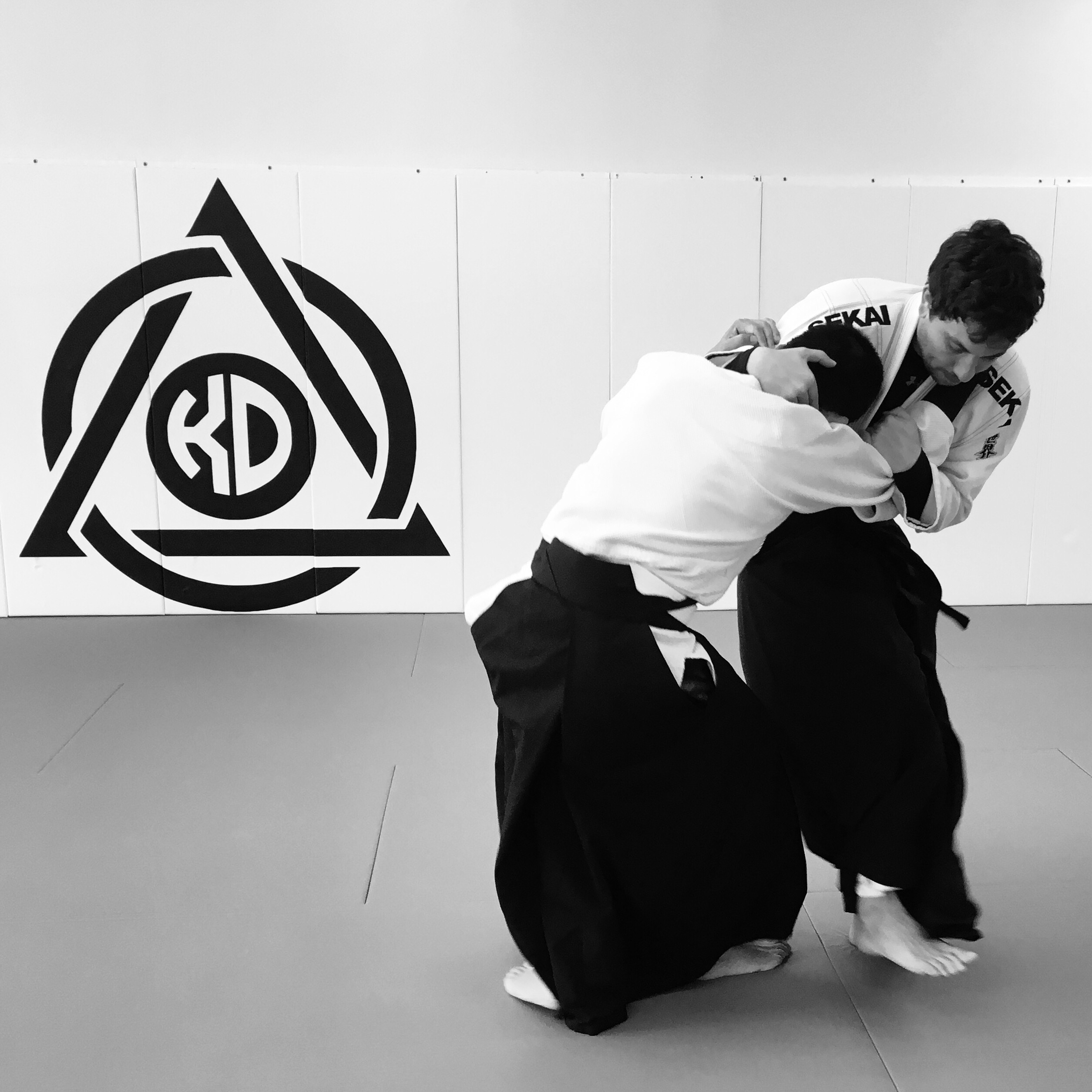
In this image, we see Reyadh applying osoto gari (large outer leg reap) on Paolo. One way to think about osoto gari is that it is iriminage with a leg sweep. This is especially useful when uke (the person receiving the throw) tries to counter tori (the person applying the throw) with irimi of his own, in this case by turning into tori and applying an underhook. The leg sweep is a great way to counter this counter, such that partners exchange irimi until one is finally thrown.
-Robert Van Valkenburgh teaches Taikyoku Budo and Brazilian Jiu-Jitsu at Kogen Dojo
At the heart of Taikyoku Budo (太曲武道) is the belief that all martial movements can be subdivided into five themes or kyoku (曲). These themes create the basis for our solo practice, but also act as a sort of filter through which to analyze and incorporate techniques from other martial studies so that the technique ‘becomes’ Taikyoku Budo.
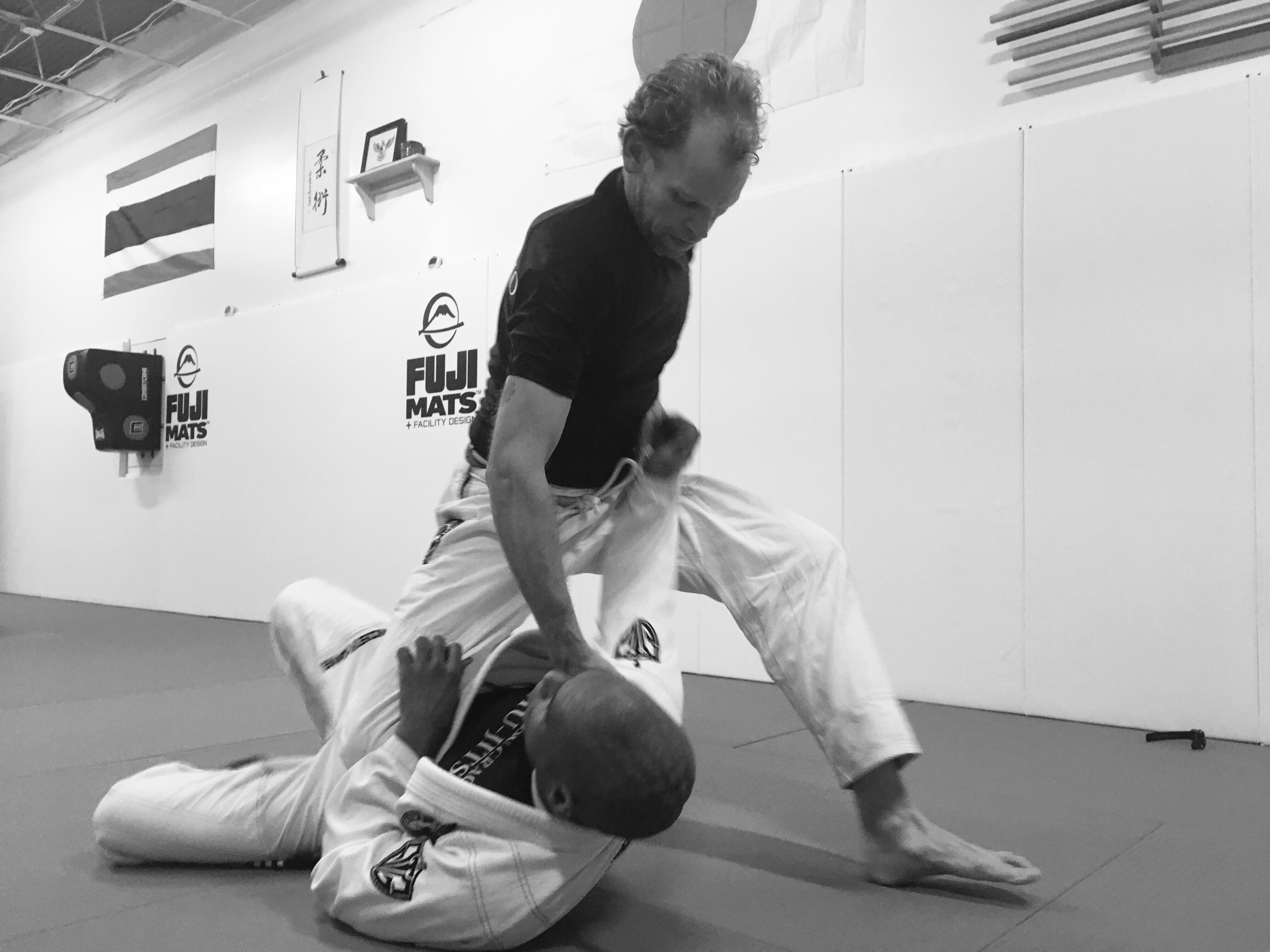
Here we we see, John, a member of the Taikyoku Budo group at Kogen Dojo practicing uki gatame (floating pin aka knee on belly) against a resisting partner from Kogen Dojo’s Gracie Jiu-Jitsu group, Bowie. Both are working together to find and shore up any instabilities in the position or holes in John’s technique.
This particular version of uki gatame is a good example of Taikyoku Budo’s fourth theme, yonkyoku, spiraling down and away from the body. Observe that as John’s right hand reaches down for Bowie’s collar, his left hand pulls up to counterbalance forces. Likewise, John’s right knee is driving into the ground through Bowie’s torso, while his left leg provides counter support into the ground on the other side, the goal being that John’s entire body works together as a unified whole, maintaining a balance of forces at all times, with as little upper body tension as possible, so that he is as mobile as he is strong from a dominant position, ready for whatever variables Bowie throws at him.
A Variation of Uki Gatame (‘floating pin) aka Knee-on-Belly
Taikyoku Budo originated as a set of principles, a different way of looking at martial art techniques and the body skills and mechanics that make those techniques work. The idea, originated by Ellis Amdur, was to give practitioners of the so-called aiki arts, aikido specifically, a set of solo exercises for conditioning the body in a way that would both engrain the movement patterns utilized in partner practice so that those would be more instinctive in a freestyle setting and would also provide a container for a specialized kind of strength training. Budd Yuhasz then saw the universality of these principles and began applying them to grappling and striking. The history of Taikyoku Budo has been written about from multiple perspectives on the Taikyoku Mind & Body site, however, so I will get directly to the point of this particular post. Taikyoku Budo requires that the practitioner maintains his or her options throughout a martial encounter.
One of the fundamental principles of Taikyoku Budo is that all desirable grappling positions are reversible. That is, for a position to be considered ideal in Taikyoku Budo, it must give the practitioner three strategic options: maintain, aggress, or egress. In other words, the practitioner’s goal is to get to a position from which he or she can control the opponent using a pin of some sort, do damage to the opponent with strikes, or get up and get away from the opponent with minimal resistance, all while minimizing the opponent’s ability to defend attacks or do counter damage. This means that any position from which the practitioner cannot easily disengage is not desirable because that position is not reversible.
Many of the best positions for submission grappling (BJJ), and even MMA, such as full mount (high mount is an exception), closed guard, or side control, do not meet this requirement because the person in the less dominant position (uke or ‘receiver’) can still hold the person in the dominant position (tori or ‘taker’) in place by way of a bear hug or the like, making it difficult to disengage and escape, even from the top position, should the circumstance warrant it. Imagine being stuck in full mount while the person on the bottom holds you there so his friends can kick you in the head or securing a perfect side control and the person on bottom suddenly pulls out a knife. These are genuine problems worth considering, but no martial art is meant to do everything perfectly. With limited time to train, we must specialize so that we can maximize our skills in whatever aspect of the martial arts we feel best suits our goals.
For Taikyoku Budo, for our ne-waza (ground grappling) training goals, uki gatame (‘floating pin’ or ‘floating hold’), commonly called knee-on-belly, knee-on-stomach, or knee ride, is the ideal position. Uki gatame is most often seen as a transitional position in submission grappling because it is not the most secure pin from which to attack the neck, arms, or legs and it is often difficult to maintain in MMA because of the slipperiness and flailing that happens in the fight, but the transitional nature of this position is exactly what makes uki gatame perfect for Taikyoku Budo, namely that it is easy to move in and out of. From uki gatame, tori can pin uke down, land devastating elbows or hammer fists, or disengage and retreat or reengage from a better angle. Uki gatame is a position of options.



 Meditations on God