There was a Brazilian jiu-jitsu (BJJ) video going around recently showing an instructor choking a student while rolling (grappling for submissions). The student tapped the instructor as a way of saying that he gave up, but the instructor did not let up on the choke, causing the student to lose consciousness. The instructor and several other students then brought the unconscious student back to a semi conscious state and continued rolling with him, putting him into various submission holds, all while joking around and laughing to the camera
The BJJ community was outraged. In jiu-jitsu, the tap, as a sign of submission, is considered sacred. It is the safety mechanism that makes all of the training possible. Everyone is taught to respect the tap, as it holds within it the integrity of the art. It allows students to trust one another implicitly, to know that no one will intentionally try to injure them. If a joint is too compromised, if the pressure under someone is too great, if a choke is too tight, or if someone is simply too worn out or uncomfortable, the tap, whether physical or verbal, must be absolute. If someone submits, you stop, period.
Watching someone blatantly and maliciously disregard this agreement was deeply disturbing because it was utterly dehumanizing. The tap is a way of saying, “No more. Stop. I have had enough. I do not want to participate in this exchange anymore.” Disregarding this request and continuing on in spite of it is criminal. If the tap means nothing, there is no integrity in jiu-jitsu. Worse, there is no morality. Jiu-jitsu, like any interpersonal exchange, must be consensual. Taking any human interaction past the point of consent, beyond the tap, is more than bullying, it is a violation of a person’s humanity.
Not long after we added regular Brazilian jiu-jitsu (BJJ) classes to the weekly schedule at my home studio, Seiya Dojo, we began expanding the schedule. Attendance was pretty good on most days considering the fact that we were training out of my home and weren’t really advertising. Things grew organically, by way of word-of-mouth, through the network of people we used to train with who were no longer training at any particular school. Monday nights, however, were consistently poorly attended.
This always seems strange to me because, at the school I used to do BJJ at, Monday night was always the most well attended class of the week. Part of that was the way the schedule was marketed at that school. It was actually very smart. The head instructor, the owner of the school, began the week with the first move or moves in a series that would continue throughout the week. It was important to show up on Monday to get the first part of the series. At Seiya Dojo, with different people training on different days, this approach was really not practical.
Consistently, on Mondays, the same one person would show up and no one else. I have always had the attitude that one person is enough for a good class, but I wanted more for him than just training with me, by myself, every week. One day, I had an idea. There was a guy from Gracie Jiu-Jitsu Maryland who I wanted to learn from. Specifically, I wanted to become a student of his knee-on-belly techniques. I asked Naqi Sayed if he would come out once every few weeks to teach a Monday class. Part of my aim was to boost class attendance, but I also just wanted to learn what Naqi had to teach. Attendance on Monday evenings went up and I started having a different guest out every Monday, including Mike Stewart, Jordan Stewart, and Toney Waldecker. That is how Guest Instructor Monday was born and the tradition continues at Kogen Dojo.
The first time I was served Chinese bitter melon by my wife’s family, I was asked if I knew how to eat bitter foods. Bitterness is not really a flavor familiar to the American palate, so I told them I was honestly not sure.
I was familiar with sour foods, but not bitter. Being willing to try almost anthing once, I tasted it. I believe it was stir-fried bitter melon with egg. It was different. It was strong, but not offputting. “I can eat this,” I told them. They looked surprised, then giggled a little, and we all ate together.
A Cambodian dinner usually consists of several different dishes. Maybe a stir-fry of some kind, a soup, and some other dish, often something left over from an earlier meal. As I ate the bitter melon stir-fry, I noticed that not everyone was eating it. My wife’s aunt told me that not everyone knew how to eat bitter foods.
The Chinese have a belief that one’s ability to eat bitter foods represents his or her ability to persevere through hardships. I knew how to eat bitter and it made my wife’s aunt smile. Perhaps I was good enough for her niece.
“For me, after leaving my home and living 13 years in a foreign country, if all I did was go there to come back and replicate what I learned over there, as if I had not returned to a very different world, I believe that I would be failing one of the functions of what koryu was, namely, to influence society. I don’t mean something simplistic like, “Well, I’ll modernize it, and I’ll use a baseball bat instead of a sword,” but it has to somehow fit and contribute to my society as opposed to being just an antique that people visit.”
This quote is an example of how a single idea can change our life’s direction. For some context, the word koryu (古流 ‘old flow’) refers to classical Japanese martial arts that originated prior to the Meiji Restoration in 1868 and Ellis Amdur is a licensed instructor in two koryu: Araki-ryu torite kogusoku and Toda-ha Buko-ryu. Ellis Amdur has had a significant influence on my martial art path and, therefore, my life in general. His writings rerouted me from Korean hapkido to the Japanese martial arts and, in an indirect way, Brazilian jiu-jitsu (something I will write about at another time). He introduced me to my teacher and friend, Budd Yuhasz, and my dojo, Kogen Dojo, is named after an amalgam of Japanese characters 古 (ko), meaning ancient or classical, and 現 (gen), meaning present or modern, that he originally put together for his martial art blog: Kogen Budo. The above quote, the topic of this post, was a seed planted in my mind that led to the creation of my own blog, the one you are reading now: Holistic Budo.
If a principle is true, that truth, that principle can be extrapolated and applied in other aspects of life. I never lived nor studied koryu in Japan, but I have been a student of martial arts for most of my adult life. Reading the above quote and the two-part interview it is from, I began thinking about all of the principles and object lessons martial art training have taught me over the years. I then began thinking about how the arts in general, music, literature and even the culinary arts, have shaped and influenced my life. If the arts have given me so much and have helped to make me who I am today, what is my contribution to the landscape? How can I pass on some of what has impacted me and influence the culture around me?
It is not that I like writing, per se. I like telling stories, stories that have meaning to me and may help others to see things from a different perspective. Whether or not anyone reads or finds value in my writing is not my concern. My goal is to have written, to have put my work into the world, to transform what is in my head or in my past into something tangible and potentially useful. For the same reason I show up to the dojo day after day to pass on what has been passed on to me, I do not write for myself, but to be part of a continuum. For me, writing is not about creation or regurgitation, but transformation, the transformation of that which has inspired me into something that may inspire others.
“You can tell real history from fake history because real history is rich and complicated. Fake history is simple and straightforward.” – Damon Smith.
Before I started the Heretics podcast with my old Xingyi instructor and friend, Damon Smith, I thought I knew a bit about martial arts. After all, I’d been practicing, researching, debating, arguing about and had generally been involved in both Chinese and Japanese martial arts for about three decades, earning a black belt in Brazilian Jiu-jitsu along the way.
Japanese martial arts had never appealed to me as a young man – a sea of emotionless robot men in white suits doing unpractical, rigid kata against the air was not my thing. Instead I gravitated towards the Chinese arts, which seemed to be more fluid and full of clever techniques. The reality was that I didn’t know what I didn’t know. But most importantly I didn’t know how Japanese martial arts made more sense once you understood the historical events that gave rise to them. Martial arts are a part of human history. To study them in isolation is to have only a partial understanding of their origins.
I can hear the counter argument to this already – “No! Martial arts were invented to give you the tools to beat the other guy’s brains in, anything else is irrelevant!” No offense, but that’s wrong. Nothing that simple is ever true. Remember, real history is always complicated.
As well as Xingyi from China, Damon is an expert in Japanese Kempo and a serious practitioner of Shamanism. Every week since November last year we’ve sat down on a Thursday night with our microphones and chipped away at a mountain of history to try and find some gold. We started the podcast in Japan around the year 1,000AD. Moving through the different Shogunate eras, from the collapse of the Ashikaga through to the warring states period (1467 – 1600), eventually resulting in the Tokugawa shogunate which lasted up to 1862. Along the way we looked at the Japanese martial traditions that built up through a mix of different influences: shrine sumo (which was way more diverse and complicated than the modern sportif version, and goes back to a time before recorded history in Japan), weapons orientated battlefield arts (which evolved into various schools of jujutsu) and schools of Chinese-influenced civilian martial arts, known as kempo, a Japanese translation of “Quan Fa”, the Chinese term for martial arts. These all added to the mix and so did their connections to various secret societies, religions and yakuza groups.
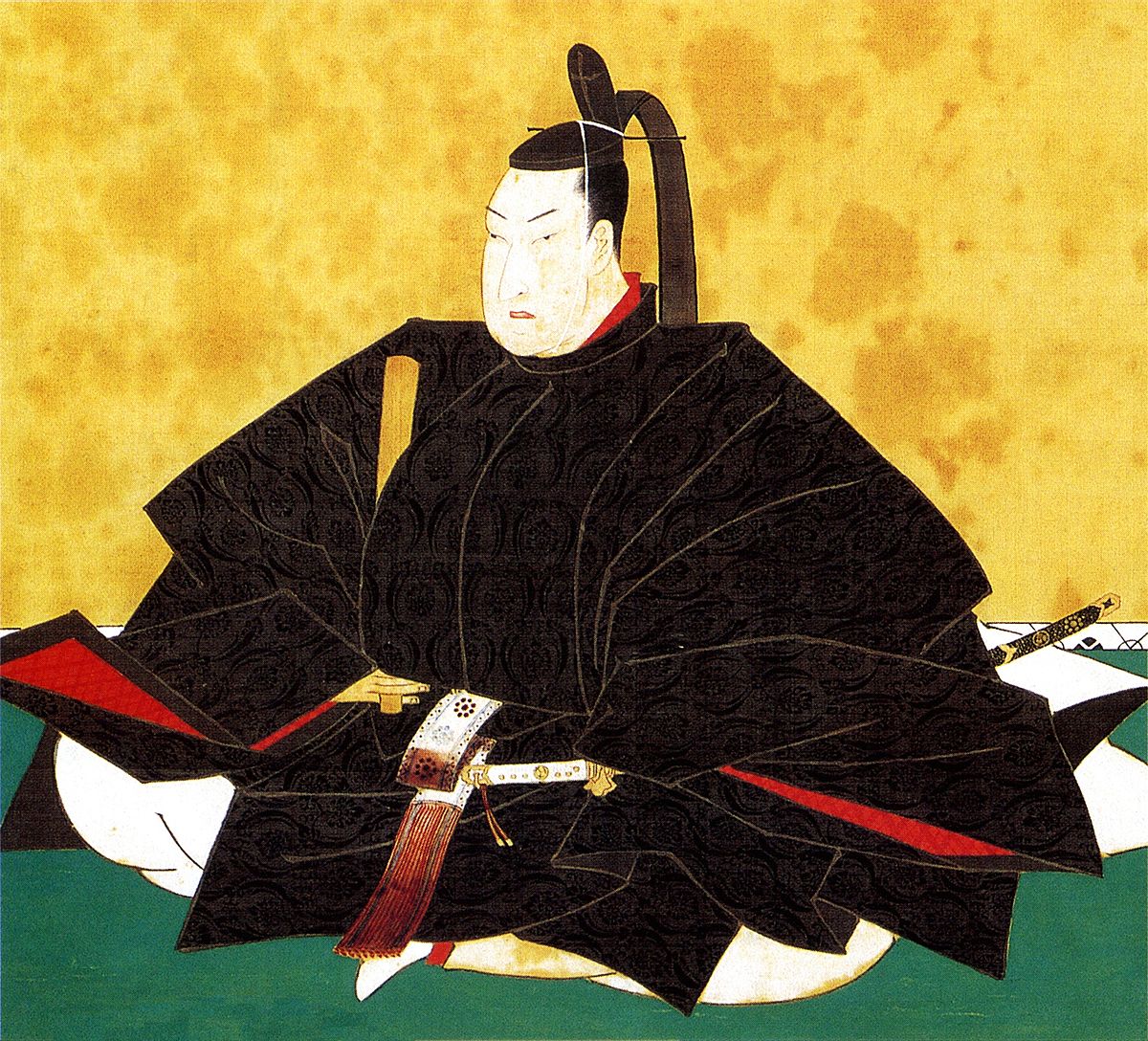
Tokugawa Tsunayoshi was the fifth shōgun of the Tokugawa dynasty of Japan.
In contrast to the preceding Ashikaga, the Tokugawa shoguns adopted the Confucian model of leadership. Everything in society became highly regulated, including religion, government, contact with other countries and, of course, martial arts. In this way any activity that could become a threat to the Tokugawa was suppressed. It was this period that saw the development the famous Koryu schools, the supposed battlefield arts of Japan preserved as martial arts. In fact, the Koryu were developed after most of the battles had stopped, and were highly controlled by the Tokugawa rulers, which explains the stilted look that was introduced to the martial arts, and still plagues many Japanese martial arts to this day. To be fair to the practitioners of this time, they had no choice. ‘Aliveness’ (to borrow the phrase from Matt Thornton) in martial arts practice was dangerous in the eyes of the Tokugawa rulers. It was a threat, so it had to go.
The Samurai of this period were also not the brave warriors of popular imagination, fighting on battlefields for their Lord’s honour. In fact, they became more like institutionalised bullies with the right to ‘kill and walk away’ to any peasant who happened to rub them up the wrong way. The Katana, the famous Samurai sword, was more often used for lopping of the heads of the defenseless peasantry, than it had been on any battlefield, where horses, guns, spear and bow ruled the day. Underground civilian martial arts in this period and secret societies were developed as a method of protecting the population from ruthless Samurai who pushed things too far.
After the Tokugawa-era ended with the bloody Boshin war followed by the Meiji Restoration (1868), Japan slowly opened up to the outside world. In fact, it was forced open by the British and Americans using violent gunboat diplomacy, but eventually the new era was embraced by the new rulers and also reflected in a new spirit of openness within the martial arts. Aliveness was back in fashion and innovators like Jigoro Kano breathed new life into the martial arts they inherited using the practice of randori (free sparring). His approach was so effective that Kano went from never having trained martial arts at all, to founding his own style in less than 6 years. Ultimately Kano’s Judo would outshine all the other styles of Jiujitsu and change the course of martial arts in Japan entirely, not to mention the rest of the world.
Kano Jigoro (right), the founder of Judo, with Kyuzo Mifune (left)
But there were also new influences coming into Japan from outside during the late nineteenth century. The Japanese were as fascinated by Western culture then as we are in the West by Eastern culture today. They looked to the West for inspiration in effective martial arts and found it in Western boxing and wrestling. The first western boxing gym opened its doors in Japan in 1896, meaning Western Boxing is much, much older than Karate in Japan (a post World War I kempo import from Okinawa in 1922) and even older than Ju Jitsu landing in Brazil (Maeda first arrived in 1914, and returned to live there in 1917 teaching Kano Ryu Jujutsu). Just think about that.
Before the shutters came down again on Japan, with the rise of militarism and nationalism as the result of rabid empire building, leading ultimately to some of the worst atrocities known in human history, some of that martial arts knowledge got out, and spread. Martial artists schooled in these new traditions of Japan travelled to Europe and America, demonstrating their prowess. One of them, Mitsuyo Maeda ended up in Brazil where he met a member of the Gracie family called Carlos Gracie. Free to pursue this randori-style approach to fighting Jiu-Jitsu evolved further in favour of effective ground-based techniques setting it on a path that would eventually lead it all the way to America and the Ultimate Fighting Championship in 1993, where Royce Gracie showcased Brazilian Jiu-Jitsu to the world.
The Meiji Restoration period also saw the rise of Shinkōshūkyō, the ‘new religions’, in Japan. In fact, these were the reinvention of old religions. This was the re-emergence of the roots of the original Shinto religion of Japan – shamanism – after being suppressed under the Tokugawa. It was from the corrupted remnants of these new/old traditions, mixed with a new martial art that claimed to be a Koryu, yet which also claimed to be older than the concept of Koryu itself (Daito Ryu), that Aikido ultimately emerged. Its connection to extreme nationalist politics, militaristic societies and a cult-like religious movements is often airbrushed from history, but it explains a lot of its chosen form of expression. And without the full picture of the history that preceded it you wouldn’t have a clue what you were looking at when you saw Morihei Ueshiba throwing people like puppets in an Aikido demonstration.
Morihei Ueshiba, the founder of Aikido, 1957.
After the horrors of the second world war were over a defeated Japan looked back to the Meiji restoration period as a golden age of liberalism. The Japanese economy, without a military to fund, and with the US capitalist model to follow, was free to grow. Post-war karate was marketed tremendously well by innovators like Mas Oyama, and pro wrestling found an audience with firebrands like Rikidozan leading the charge. These influences, mixed with the indigenous kempo, and everything else that had gone before, funneled into a new form of fighting that we now know today as MMA. And while the focus has switched to America in modern times, with the UFC, every MMA fan worth his salt will have heard of the PRIDE FC organisation in Japan and legends of the ring like Kazushi Sakuraba. But it was also an organisaion that became famous for featuring some of the best fighters from outside the country – Rickson Gracie, Fedor Emelianenko, Chuck Liddell to name but a few, and of course it was all tied up in Yakuza money.
Rikidozan – one of the most influential men in professional wrestling history.
Our History of Jiu Jitsu and Kempo series ended up being 5 episodes long, and we feel like we only really scratched the surface. If there’s one thing I’ve learned so far it’s that it’s not the art that is the issue, but the way it is trained that results in it being effective. We’re just started a new series in the podcast on China, beginning with its unification under Qin Shi Huangdi and moving forward from his short lived Qin Dynasty to the golden age of the Han Dynasty. I expect there will be many more revelations to come, particularly about the Chinese martial arts. Come and join us.
About the Author:
Graham Barlow started martial arts with Tai Chi Chuan and Choy Lee Fut in 1993, then added Xingyi in 2001 before finding BJJ in 2011 and getting his black belt in 2018. He currently trains at Gracie Barra in Bath, UK and is also a member of the Yongquan Martial Arts Association. Graham runs a couple of marital art blogs and a podcast. You can read about what he’s up to at Tai Chi Notebook, The BJJ Notebook, and listen to the Heretics podcast on iTunes or Spreaker.