Skip to content

Meditations on God

  • Robert Van Valkenburgh

  • 60 Years to Think About It

    When my wife and I were engaged, we got into an argument and, partially joking, I made the comment, “What am I getting myself into?” Without missing a beat, she replied, “Well, you have the next 60 years to think about it.” We both laughed and the argument dissipated.

    When my paternal grandmother passed away, which happened before my wife and I met, my grandfather arrived to the viewing in a suit, as is appropriate, especially for someone of his generation. My aunt, my uncle’s wife, commented, “You look very nice, Dad.” “I haven’t had to pick out my own clothes in 60 years,” my grandfather responded.

    I looked up to my grandparents very much. They were a beacon of morality, generosity, kindness, and faithfulness. I am not sure that a day went by when they did not bicker with or nag at each other about something, but I never once doubted that they loved each other or that they would be together ‘for as long as they both would live,’ as the saying goes.

    Ravy knew this. She knew my grandfather and she knew about my grandmother and how much they meant to each other and to me. “You’ve got the next 60 years to think about it” was her way of saying that she and I were and are in this for the long haul, no matter how difficult it may be at times.

    Marriage is a choice. It is a decision. It is a decision made and remade daily, to continue on with each other, in spite of each other, and for each other. It is a commitment precisely because it is difficult. Easy things do not need commitments or dedication. They are easy, after all.

    Here’s to another 51 years, my dear, come what may.

    Share this:

    • Share on X (Opens in new window) X
    • Share on Facebook (Opens in new window) Facebook
    Like Loading…
    December 5, 2018

  • Design: Protect Ya Neck

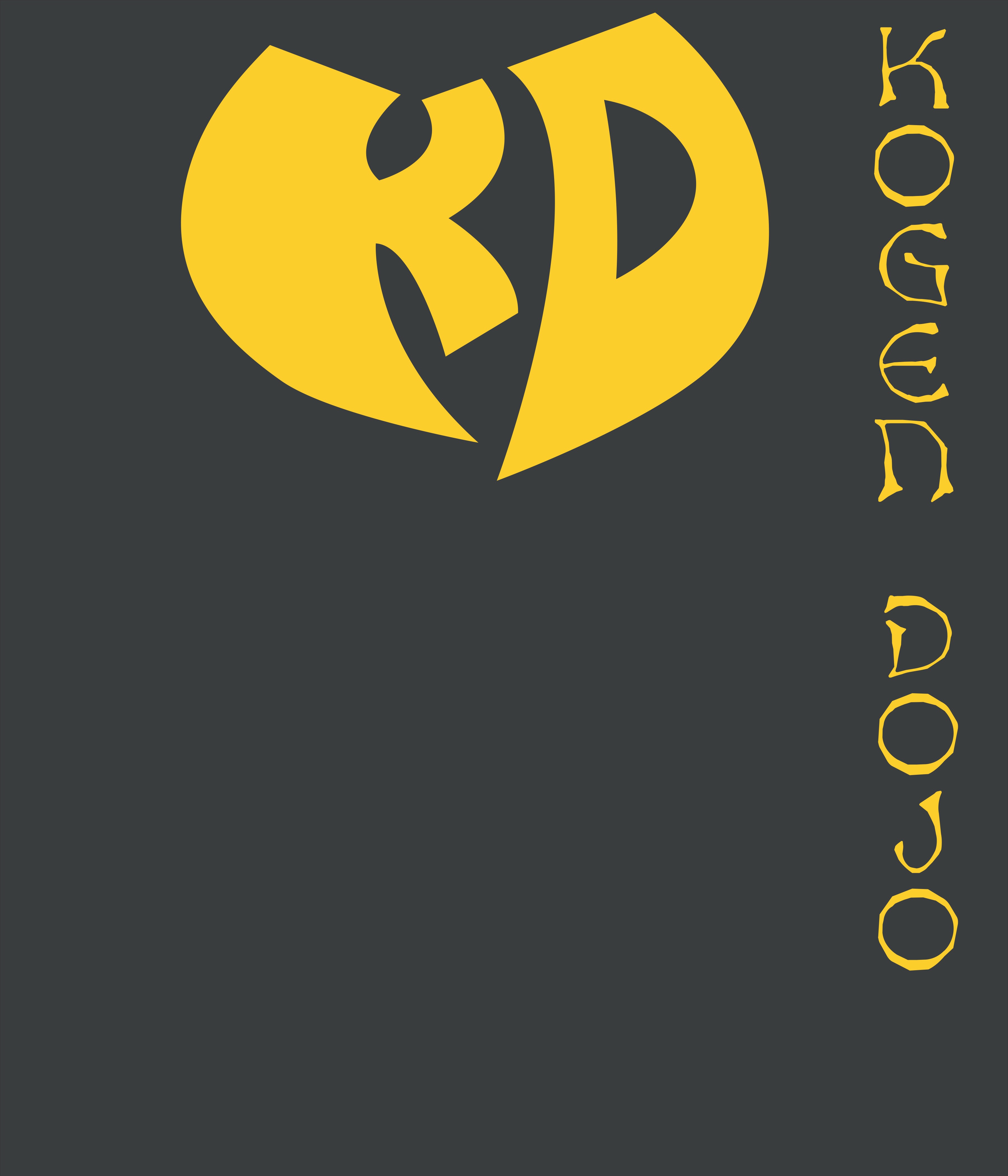
    Design has become one of my creative passions. Like many of my hobbies, designing logos, flyers, websites, etc. started with an idea and a compelling urge to see it come to life. Below is a design I did for my martial art school, Kogen Dojo, where I teach and train.

    I designed both our main logo pictured on the back of this shirt (more on that later) and the Wu-Tang Clan inspired KD pictured on the front of the shirt. I’ll eventually write about the influence Wu-Tang Clan, specifically RZA’s vision for it, has had on me, but for now, I just wanted to show off the design.

    The Protect Ya Neck phrase (my brother, Matt’s idea) is highly relevant to the martial arts we offer at Kogen Dojo because all three arts we teach attack the opponent’s neck in some way. In Gracie Jiu-Jitsu, this is done through chokes and strangulations. In Muay Thai, the neck is used in the clinch to add leverage to strikes and throws. Taikyoku Budo, my main study, does both of these, as well as targeting the neck with bladed weapons and breaks.

    Protect Ya Neck!

    If you are interested, these shirts are available through Kogen Dojo.

    For design work, contact me HERE.

    39.073857 -76.547111

    Share this:

    • Share on X (Opens in new window) X
    • Share on Facebook (Opens in new window) Facebook
    Like Loading…
    November 29, 2018

  • Upgrade Your Team (But Invest In Them First)

    When I was managing a coffee shop in the early 2000’s, I had monthly business review meeting with my District Manager. At one of these meetings, he asked me if I was hiring. I said, “Not right now.” As if he was expecting that answer, he immediately rebutted, “Yes you are.” “I’m fully staffed right now,” I replied. “No. You are always hiring. There is always someone on your team that you can upgrade,” he said.

    I understood this to mean that I should start looking for the weakest link on my team and replace him or her with someone who had the potential to be better. This was not difficult for me because I always had my employees inventoried in my head, in terms of technical skill level, ability to adapt under pressure, reliability, and overall personality. I knew who I could count on in a pinch, who would get the job done, and who was only there for the convenience and the paycheck. In my time as a manager at that store, I had to upgrade a lot of people, all the while developing those who remained.

    There was not a person I let go, however, who was not given multiple opportunities to improve and explicit instructions on how to do so, to at least meet the minimum expectations for the job he or she was hired to do. This is the part that my District Manager left out when he told me to upgrade my employees, but I knew through his example that I should do everything in my power to work with those I hired, to invest the necessary time and energy into them so that they could improve. I owed it to them to treat them with dignity and to give them the opportunity to grow, even if they ultimately chose not to. Success and failure do not occur in a vaccum.

    Share this:

    • Share on X (Opens in new window) X
    • Share on Facebook (Opens in new window) Facebook
    Like Loading…
    November 29, 2018

  • Make Something

    Obviously, it is not easy work to change the world or how it functions. It is not easy to do something new, to conceive of and make manifest that which never was before. However, we are beings of creation who exist to create. To simply accept that which is, without question, and without adding some piece of ourselves to the world is to have never truly lived.

    While it may take more effort and dedication to create than not to, it is far more exhausting to do nothing. It is far more taxing on the soul to conform to the uninteresting drudgery that is everyday existence than to try to make your existence meaningful. It is infinitely more exhausting to be normal and boring than to push back against the predicable and mundane.

    Make art. Make music. Make change. Make something.

    Share this:

    • Share on X (Opens in new window) X
    • Share on Facebook (Opens in new window) Facebook
    Like Loading…
    November 28, 2018

  • It’s (Not) All The Same

    When our Taikyoku Budo group first started cross-training in Brazilian jiu-jitsu out of my home dojo (Seiya Dojo), my friend Dwayne Bowie (now a partner with my brother and myself at Kogen Dojo), who was then a BJJ purple belt, came in every Wednesday night to co-teach with me. The idea was that I would show a Japanese jujutsu throw or takedown that we were working on and Bowie would then teach a technique on the ground from wherever we found ourselves at the end of the throw. It was like a laboratory where we would question, experiment, and determined what truly worked.

    The exchange of ideas between Bowie, myself, and the training group was truly special. In fact, it was that vibe, the synergy between us, as Bowie liked to say, that planted the seeds for what would become Kogen Dojo. Originally, the goal was to supplement our Taikyoku Budo training, so that the BJJ was additive. However, as good as the result of this training model was, some lines began to blur. By training together the way we were, some separation between the two arts began to get lost. One night, Bowie and I were riffing off of each other and he exclaimed in excitement, “Wow! This stuff (meaning Taikyoku Budo and Brazilian jiu-jitsu) is all the same!” At first, I concurred, but then I realized that something was wrong with this statement. If they were both the same, why bother doing both?

    That day was a turning point for the Taikyoku Budo training group because we had to decide what our training focus was going to be on the martial side. The body mechanics had already been clearly defined by our teacher Budd Yuhasz. Brazilian jiu-jitsu tends to focus on one-on-one empty handed grappling with the purpose of achieving submissions from a variety of positions, sometimes regardless of where that position leaves you when the match or the fight is over.

    There is nothing wrong with this, but Taikyoku Budo, if we were to claim at least some connection, no matter how loose, to classical Japanese martial arts, must have a different standard. In koryu jujutsu (classical Japanese grappling of the samurai, also known as yawara, torite, kogusoku), grappling was always done with at least one person being armed with a blade, and it always considered the possibility of having to face multiple opponents in succession. Taikyoku Budo had to evolve along these lines if we were to be unique and have our own identity. It couldn’t be, can’t be, the same as Brazilian jiu-jitsu, even if pulling inspiration from some of its training methods and techniques.

    Share this:

    • Share on X (Opens in new window) X
    • Share on Facebook (Opens in new window) Facebook
    Like Loading…
    November 27, 2018

Previous Page Next Page

Create a website or blog at WordPress.com

Loading Comments...

    • Subscribe Subscribed
      • Meditations on God
      • Join 265 other subscribers
      • Already have a WordPress.com account? Log in now.
      • Meditations on God
      • Subscribe Subscribed
      • Sign up
      • Log in
      • Report this content
      • View site in Reader
      • Manage subscriptions
      • Collapse this bar
    %d